
Service and repair of centrifugal and reciprocating compressors
We service single-shaft and integrally geared, single- and multi-stage centrifugal compressor trains by Siemens Energy, Dresser-Rand, Mitsubishi Heavy Industries, Howden, Kobelco and Hanwha, as well as reciprocating compressor trains: inspections, repair, seals, bearings, anti-surge protection. Team record: the Yamal LNG boil-off gas compressors and the Arctic LNG 2 feed gas and boil-off gas compressors.
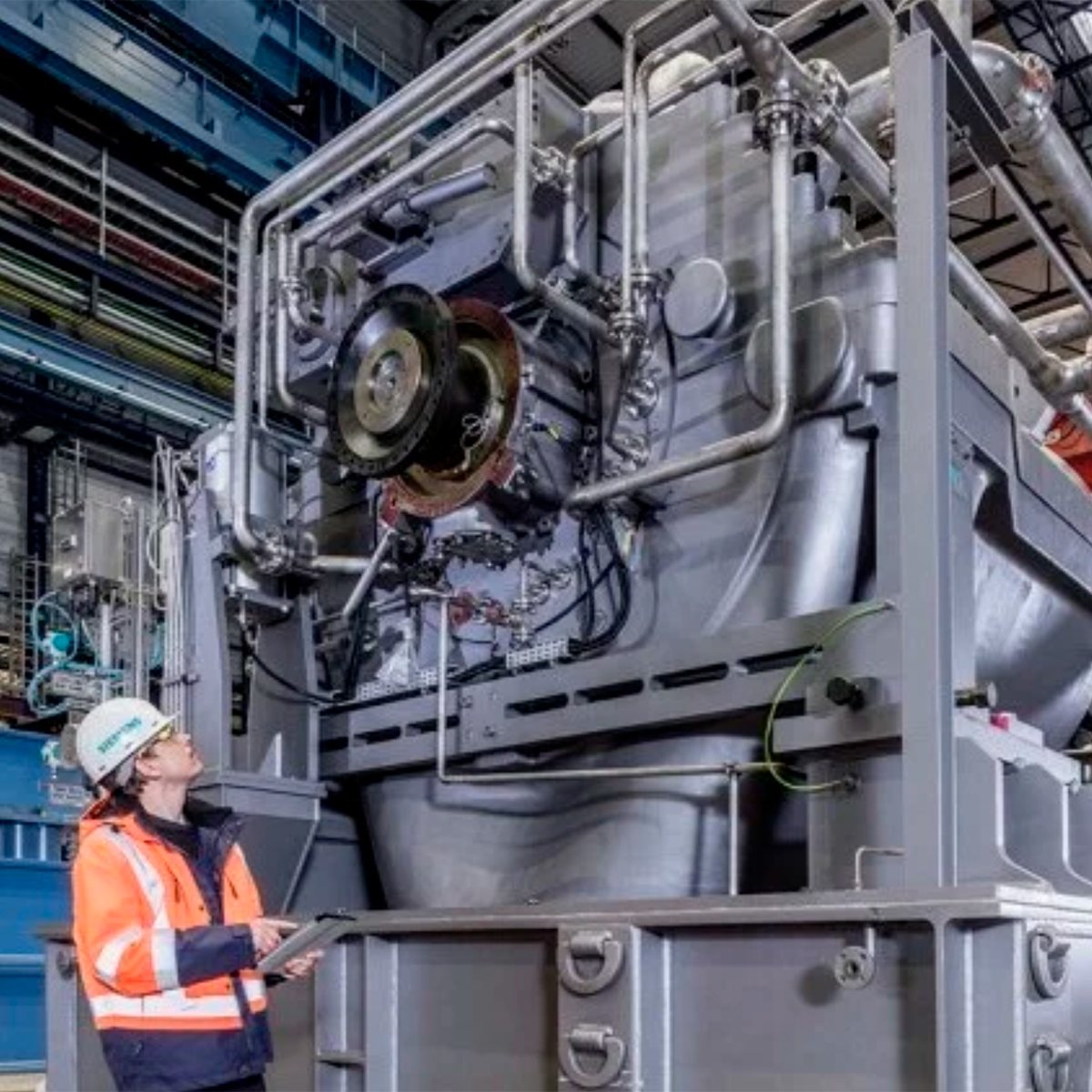
Scope
- inspections and diagnostic survey
- maintenance, medium and major overhauls
- dry gas, barrier and labyrinth seals: selection, replacement, seal gas system adjustment
- bearings and bearing shells
- anti-surge protection and capacity control systems
- vibration diagnostics and field balancing
- control and vibration monitoring systems
- original spare parts
Compressor repair: what each type of work includes
Compressor unit repair varies in depth, from a diagnostic survey to a major overhaul with the casing opened and the flow path dismantled. Intervals between overhauls, in running hours, are set by the manufacturer’s documentation and the operator’s maintenance regulations, and the scope of each repair is refined to the actual condition of the machine.
| Type of work | Typical scope | Result for the customer |
|---|---|---|
| Diagnostic survey | inspection of the train and auxiliary systems; analysis of trends in vibration, bearing temperature, rotor axial position and event logs; assessment of the condition and completeness of spare parts | condition assessment, maintenance forecast and a list of required parts |
| Minor inspection | based on running hours, to the scope of the operating manual: inspection of bearings and coupling, checks of alignment, the lube oil system, the seal gas system, instrumentation and protections — without opening the compressor casing | a decision on operation until the next inspection and a list of findings |
| Medium overhaul | overhaul of bearings, seals and couplings, replacement of worn parts, clearance checks, adjustment of auxiliary systems | restored components and measurement records |
| Major overhaul | opening the casing (for vertically split machines, withdrawing the internal bundle), inspection of the rotor, impellers, diaphragms and labyrinths for defects, replacement of seals and bearings, rotor balancing, reassembly, alignment with the driver and start-up with vibration monitoring | a machine ready for start-up; measurement reports and operating recommendations |
| Reciprocating compressor maintenance and repair | replacement of valves, piston and rider rings and piston rod packing; checks of crossheads, bearings, clearances and cylinder wear | restored capacity and tightness |
What to attach to the request
- the report on the last repair, the clearance records and the running hours since that repair;
- trends in vibration, bearing temperature and rotor axial position over recent months;
- the log of protection trips and surge events;
- the list of spare parts in stock.
The more complete the data, the more accurate the work programme and the list of parts to be ordered in advance.
Centrifugal and reciprocating compressors: what wears and what is monitored
Centrifugal and reciprocating compressors wear in different ways, so their diagnostics differ too. In a centrifugal machine, the key items are the rotor, journal bearings and shaft seals; in a reciprocating machine, the valves, rings and piston rod packing, which are replaced at scheduled intervals.
| Criterion | Centrifugal | Reciprocating |
|---|---|---|
| Main wearing components | bearings, dry gas and labyrinth seals, impellers | valves, piston and rider rings, piston rod packing, crossheads |
| Monitored in operation | shaft vibration, rotor axial position, bearing temperature, seal gas leakage | valve temperature, piston rod drop (rider ring wear), crosshead vibration, cylinder pressure–volume diagrams |
| Vibration evaluation | manufacturer’s limits; ISO 20816-3:2022 (GOST R ISO 20816-3-2023) | manufacturer’s limits; ISO 20816-8:2018 (GOST R ISO 20816-8-2023) |
| Machine standard | API 617, 9th edition, 2022 | API 618, 6th edition, 2024 |
| Protection systems | to API 670 (6th edition, 2025): shaft and casing vibration, rotor axial position, surge detection | to API 670: piston rod position and drop, crosshead vibration |
API standards set requirements for a new machine. In repair, the reference is the tolerances and clearances in the manufacturer’s documentation for the specific train. What each standard covers is explained in the glossary entry API standards for compressors and turbines. Vibration measurements and on-site rotor balancing are carried out as part of our vibration diagnostics and field balancing service.
Compressors we service
| Manufacturer | Models and types | More |
|---|---|---|
| Siemens Energy | STC-SH, STC-SV, STC-SR, STC-SX, STC-SP, STC-STO, STC-GV, STC-GVT, STC-GC, STC-GT, STC-GTO, STC-GO, STC-SOF | SST and STC service · Spare parts |
| Dresser-Rand | centrifugal Datum, Datum R, Datum C, Datum A, Datum I (ICS), Datum P; reciprocating ESH, PHE, HSE, HHE, BDC, MOS, HOS, HOSS, M/B-line | Dresser-Rand service · Spare parts |
| Mitsubishi Heavy Industries | centrifugal compressor trains | MHI service |
| Howden | centrifugal compressor trains | Howden service |
| Kobelco | compressor trains, anti-surge protection | Kobelco service |
| Hanwha | compressor trains, control systems | Hanwha service |
Manufacturer names and designations are given to identify the equipment we service. Trademarks belong to their respective owners. Energy Management LLC is an independent service company.
Dry gas seals: why they fail and what is checked on replacement
A dry gas seal most often fails because of contamination: liquid, solid particles or oil enter the gap between the seal rings, the rings touch and are damaged. That is why the system that supplies clean, dry gas to the seal is checked together with the seal itself.
- Condensate. Under API 692 (1st edition, 2018), seal gas and buffer gas are supplied at a temperature at least 20 K above the dew point so that no liquid forms in the seal cavity. If this margin cannot be maintained, a seal gas heater is added to the system.
- Particles. The gas is cleaned by filters; a rising pressure drop across them signals that the filter elements need replacing.
- Bearing oil. A barrier seal supplied with nitrogen or air separates the gas seal from the oil-filled bearing housing. Barrier gas is turned on before the lube oil system is started.
- Leakage. Rising gas flow to the primary vent can indicate wear or damage of the seal rings before a failure.
The compressors for which we select and replace seals, and how replacement on site proceeds, are shown on the dry gas seals for compressors page.
Anti-surge protection after repair
After flow path repair, the anti-surge protection is checked before the compressor is brought up to its operating point. New impellers, labyrinths and changed clearances can shift the machine’s performance curve and, with it, the surge line relative to the control line set in the control system.
- calibration of the flow, pressure and temperature transmitters used to calculate the operating point;
- a check of the anti-surge valve stroke and opening time;
- a check of alarms, protections and the surge event log in the train control system;
- where necessary, surge tests and adjustment of the control line to the actual performance curve.
Design, tuning and upgrading of anti-surge systems are described on the anti-surge control page.
How the work proceeds
- 1
Request
Model, serial number, running hours, what happened.
- 2
Diagnostic survey
Condition of the train, seals, bearings and anti-surge protection.
- 3
Work programme
Scope, spare parts and personnel agreed with the customer.
- 4
Execution
Work on site; a resident engineer where needed.
- 5
Report
Technical report, recommendations, plan for the next inspections.
Example: scheduled inspection of Siemens STC-SV turbocompressors
In July 2023, the company’s specialists carried out a scheduled Level 1 inspection of two Siemens STC-SV (08-7-A) turbocompressors at the gas condensate treatment plant of Gazprom Pererabotka LLC, a facility in the Far North. The work was performed under a works contract as part of a scheduled repair.
The STC-SV is a single-shaft centrifugal compressor with a vertically split casing. According to the manufacturer, its internals are assembled into a bundle that is withdrawn axially from the casing without removing the process gas piping.
In its letter of appreciation dated 6 October 2023, No. 15520, GSP Remont LLC wrote: “We note the high qualifications of your company’s staff and express our gratitude for the high-quality performance of the work” (translated from Russian). The machines and services that oil and gas facilities need are shown on the equipment and service for the oil and gas industry page.
Projects and related pages


Questions and answers
Do you replace dry gas seals on site?
Yes: we select the seal by machine model, replace it and adjust the seal gas system at the customer's site.
What should we do after a compressor surge?
Record the parameters and event logs and avoid restarts until the machine is checked. Our engineer will assess the flow path and seals and check the anti-surge protection settings.
Do you service reciprocating compressors?
Yes: Dresser-Rand reciprocating compressor trains — ESH, PHE, HSE, HHE, BDC, MOS, HOS, HOSS, M/B-line.
When does a compressor need a major overhaul?
The interval between major overhauls, in running hours, is set by the manufacturer’s documentation and the operator’s maintenance regulations. An earlier overhaul is needed if trends show rising vibration or bearing temperature, a shift in rotor axial position, increasing seal gas leakage or a drop in capacity. The decision is based on a diagnostic survey, and the scope of work is refined after the casing is opened and the parts are inspected for defects.
How does reciprocating compressor repair differ from centrifugal compressor repair?
In a reciprocating compressor, the valves, piston and rider rings and piston rod packing wear faster: they are replaced at scheduled intervals, usually without fully dismantling the machine. A centrifugal compressor wears more slowly, but its major overhaul is more complex: opening the casing, inspecting and balancing the rotor, replacing the shaft seals and checking the anti-surge protection at start-up.
Which standards are used to evaluate compressor vibration?
First of all, the manufacturer’s limits in the operating manual. General evaluation zones are given by ISO 20816-3:2022 for rotary compressors, including centrifugal ones, and by ISO 20816-8:2018 for reciprocating compressor systems; in Russia, they are adopted as the identical GOST R ISO 20816-3-2023 and GOST R ISO 20816-8-2023. Requirements for the protection systems that trip the machine when vibration or rotor axial displacement setpoints are exceeded are set out in API 670 (6th edition, 2025).
Engineering team
Rotating equipment service