
Service and equipment for nuclear power
High-voltage equipment, high-voltage testing and service for nuclear power facilities. The team’s work has been acknowledged by Novovoronezh NPP, a branch of Rosenergoatom Concern JSC (2025), and Akkuyu Nuclear JSC (2025): the letters of appreciation are published in the news.
Industry task → our equipment and services
| Industry task | Equipment | Services |
|---|---|---|
| Power evacuation from the plant | GIS 110–550 kV | On-site GIS testing |
| Switching in an outdoor switchyard | SF6 circuit breakers | Service for 110–750 kV high-voltage equipment |
| Insulation condition monitoring | Test laboratory up to 750 kV | Partial discharge measurement |
| Readiness for emergency replacement | Emergency stock | Installation supervision of new equipment |
NPP switchyard: why it faces stricter requirements
The high-voltage switchyard connects a nuclear power plant to the grid: through it the plant exports power and receives power from the grid. IAEA Safety Guide SSG-34 counts the switchyard as part of the preferred power supply, the normal supply for all plant systems important to safety; if it is lost, standby power sources take over. The same guide notes that, to keep the plant’s grid connections secure, it may be necessary to agree with the transmission system operator that grid equipment in the plant switchyard is maintained to a higher standard, or tested or inspected more frequently, than other grid equipment.
This leads to three groups of work on power evacuation equipment:
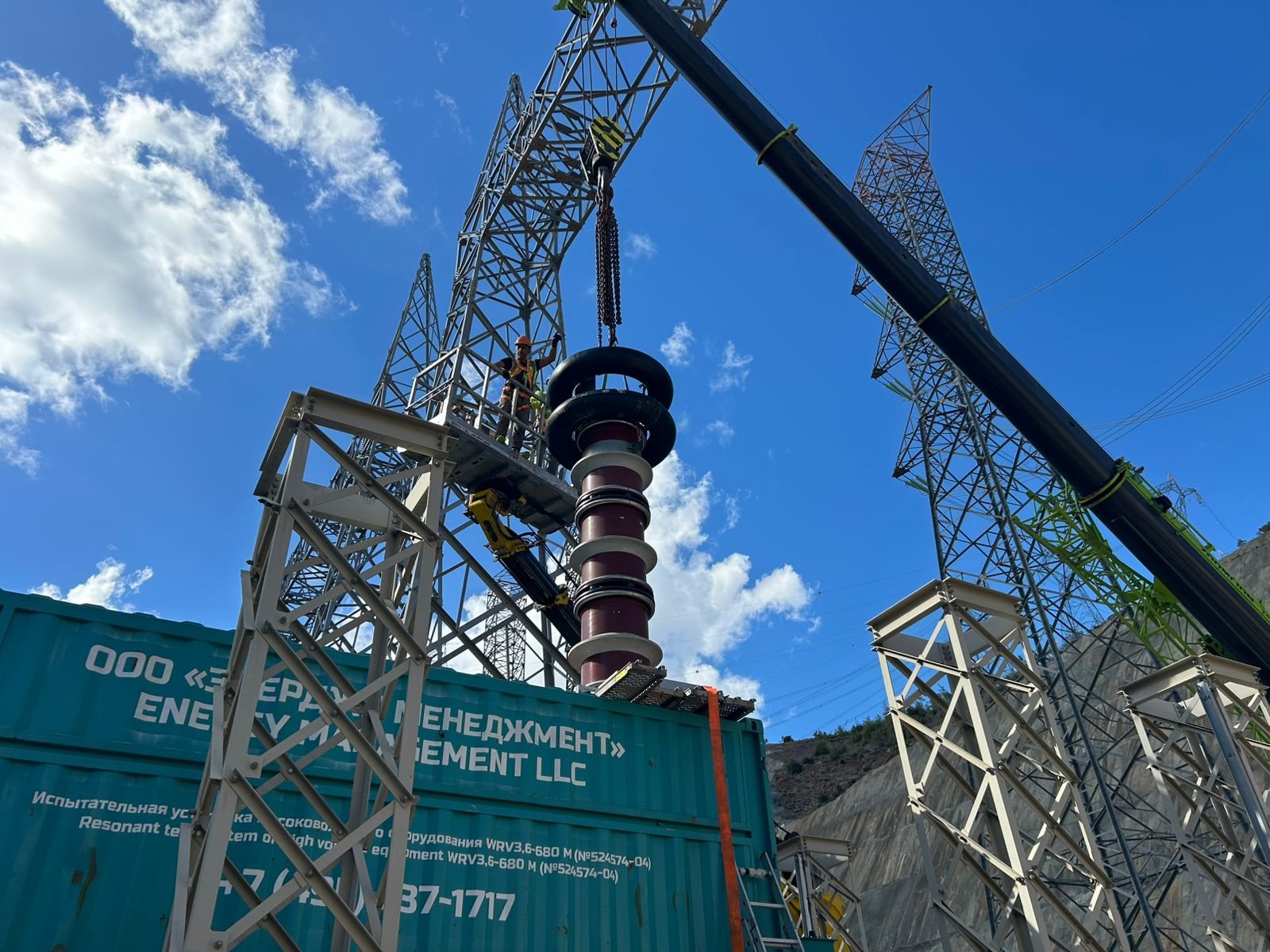
- Before energisation, newly installed GIS is tested on site at elevated voltage with partial discharge measurement to detect defects from transport and installation. Our high-voltage test laboratory carries out these tests with mobile resonant test systems; see on-site GIS testing for details.
- In operation: diagnostics, maintenance without pumping out the SF6, repair and upgrades of GIS, SF6 circuit breakers, disconnectors, and current and voltage transformers rated 110–750 kV, under a service contract or on request (service for high-voltage equipment).
- In case of failure, the service contract provides for consultancy in abnormal situations and an emergency stock that is built up and replenished over the term of the contract.
Letters of appreciation
Work at nuclear power plants confirmed by customer letters
The company carried out high-voltage tests of 400 kV GIS at the Akkuyu NPP construction site in Turkey and took part in emergency restoration work at Novovoronezh NPP-2. The table lists only work confirmed by customer letters. At Akkuyu NPP the company has carried out a range of work to enable power evacuation; Akkuyu Nuclear JSC recognised two of these jobs in letters of appreciation. Scans of all the letters are in the Letters of appreciation section.
| Site | Work | Customer letter |
|---|---|---|
| Akkuyu NPP, 400 kV GIS | high-voltage tests with partial discharge measurement of bay No. 13 and the section busbars of the right-hand part of the 400 kV GIS, under a contract of 10 September 2025 | Akkuyu Nuclear JSC, letter of 4 November 2025 |
| Akkuyu NPP, 400 kV GIS and 400 kV SF6 bus ducts | high-voltage tests with partial discharge measurement for energising the right-hand part of the 400 kV GIS | Akkuyu Nuclear JSC, letter of 22 December 2025 |
| Novovoronezh NPP-2, unit 2, 500 kV Donskaya substation | participation in emergency restoration work to replace a circuit breaker, together with the plant’s maintenance staff, October 2025; towards the end of the repair, high-voltage test equipment was brought in from Moscow, and the tests confirmed the quality of the work | Novovoronezh NPP, a branch of Rosenergoatom Concern JSC, letter No. 9/Ф0701/203022 of 21 November 2025 |
From the Novovoronezh NPP letter (translated from Russian): “Effective action in repairing the 500 kV switchgear made it possible to avoid downtime of the main equipment and to prevent any reduction in power output.”
What makes it different
- Requirements
Working to the plant’s procedures
Personnel clearance, agreed work programmes and reporting at every stage — as is the practice at nuclear facilities.
- Testing
A test laboratory up to 750 kV
A mobile test laboratory with resonant test systems for GIS testing and partial discharge measurement on site; registered with Rostechnadzor.
- Recognition
Letters from customers
Novovoronezh NPP and Akkuyu Nuclear acknowledged the promptness and quality of the work in letters of appreciation; projects for the nuclear industry are not yet described on the site.
How we prepare work at an NPP site
Work at a nuclear power plant starts with agreeing the documents. Before the team travels, we usually settle:
- input data: type and manufacturer of the GIS or circuit breaker, voltage class, single-line diagram and section boundaries, factory test reports and the manufacturer’s instructions;
- the work or test programme, agreed with the plant operating organisation and, on a unit under construction, with the installation contractor as well;
- the outage window and the procedure for taking equipment out of service;
- personnel access: to the site under the plant’s access control rules, and to work in the electrical installation under a work permit; requirements for electrical safety qualification groups are described on the high-voltage test laboratory page;
- reporting documents: test and measurement reports, a conclusion on the results and recommendations on any findings.
The scope and acceptance criteria of the tests are set by the manufacturer’s instructions, by standards (for GIS, GOST R 54828-2022 and IEC 62271-203) and by the operating organisation’s documents. At a site abroad, the requirements of the host country and of the project are added. In Russia, the laboratory’s right to perform acceptance tests and measurements on electrical equipment up to 750 kV is confirmed by Rostechnadzor certificate No. 9834 of 20 December 2024, listed on the Licences and approvals page.
Questions and answers
What do you do for nuclear power plants?
We supply high-voltage equipment and carry out high-voltage testing and service of the power evacuation equipment.
Which nuclear customers have acknowledged your work?
Novovoronezh NPP, a branch of Rosenergoatom Concern JSC (2025), and Akkuyu Nuclear JSC (2025); the letters are published in the news and in the “Letters of appreciation” section.
Are nuclear projects described on the site?
Not yet: project descriptions are published once agreed with the customer.
What work have you done at nuclear power plants?
At the Akkuyu NPP construction site in Turkey: high-voltage tests with partial discharge measurement of the 400 kV GIS and 400 kV SF6 bus ducts, including tests for energising the right-hand part of the GIS. At unit 2 of Novovoronezh NPP-2, the company’s specialists took part in emergency restoration work to replace a circuit breaker at the 500 kV Donskaya substation. The customers recognised both jobs in letters of appreciation.
Why does an NPP switchyard face special requirements?
Through the switchyard the plant not only exports power but also receives power from the grid, including for systems important to safety. IAEA Safety Guide SSG-34 treats this path as part of the preferred power supply for those systems. It also notes that it may be necessary to agree with the transmission system operator that grid equipment in the plant switchyard is maintained to a higher standard, or tested or inspected more often, than other grid equipment.
What should be prepared for a GIS test request at an NPP?
The GIS type and manufacturer, voltage class, number of bays, a single-line diagram showing the boundaries of the test sections, the factory test reports and the manufacturer’s instructions with the on-site test criteria. Please also state the plant’s requirements for personnel access and documentation, and the preferred work window. Based on this data, we agree the test programme with you and the operating organisation.