
Hydrogen compressors
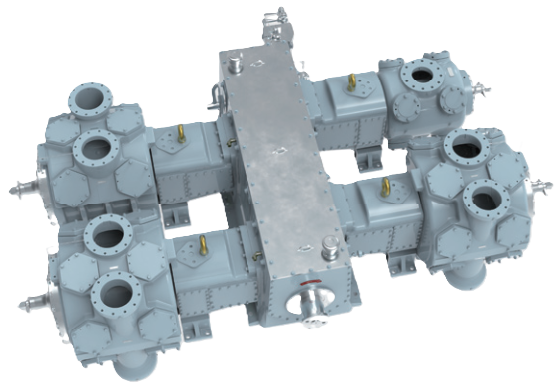
Three types of machine for compressing hydrogen and hydrogen-rich mixtures: reciprocating to API 618 — up to 50 MPa and 115,000 m³/h; diaphragm — up to 45 MPa at flows up to 1,000 Nm³/h, with the gas separated from oil and atmosphere by a diaphragm; centrifugal to API 617 — hydrogen-rich mixtures at pressures up to 15 MPa and large flows. The type is chosen for the gas composition, pressure and flow.
Key facts
- Reciprocating to API 618: discharge pressure up to 50 MPa, flow up to 115,000 m³/h.
- Diaphragm: up to 45 MPa at flows up to 1,000 Nm³/h; the gas is separated from oil and atmosphere by a diaphragm, so hydrogen purity is preserved.
- Centrifugal to API 617: hydrogen-rich mixtures at pressures up to 15 MPa and large flows.
- The machine type is set by the gas composition, the required pressure and the flow.
- Where gas purity matters — leak-tight, oil-free compression.
- Explosion-protected equipment and electric drive.
Type comparison for hydrogen
| Parameter | Reciprocating | Diaphragm | Centrifugal |
|---|---|---|---|
| Discharge pressureMPa | up to 50 | up to 45 | up to 15 |
| Flow | up to 115,000 m³/h | up to 1,000 Nm³/h | large flows |
| Gas purity | by cylinder design: lubricated or oil-free | preserved: the gas is separated from oil and atmosphere by a diaphragm | hydrogen-rich mixtures; leakage limited by dry gas seals |
| When chosen | high pressure at medium flow | pure hydrogen at small flow | large flow at moderate pressure |
| Standard | API 618 | — | API 617 |
Why the compressor type depends on hydrogen content
Hydrogen is the lightest gas: its molar mass is about 2 g/mol, roughly one-fourteenth that of air. A hydrogen compressor is therefore chosen first by the hydrogen content of the gas and the required pressure ratio.
- Centrifugal. Stage head is set by impeller tip speed, and a light gas gains little pressure per stage: to compress pure hydrogen to the same ratio as natural gas, the impeller tip speed must be about three times higher. Centrifugal machines are therefore used for high-flow hydrogen-rich mixtures: hydrocarbon impurities make the gas heavier, so fewer stages are needed for the same pressure ratio. They are usually driven by an electric motor or a mechanical drive steam turbine.
- Reciprocating. A positive-displacement machine: the pressure ratio hardly depends on the molar mass of the gas. Make-up hydrogen for hydrotreating and hydrocracking units is usually compressed by reciprocating compressors.
- Diaphragm. Also a positive-displacement machine, so the lightness of hydrogen does not hinder it. It is chosen where the flow is small and the gas must not come into contact with oil — for storage, fuelling and fuel cells.
Design features
- Leak-tightness
- hydrogen is a light gas that escapes easily; the gas path and seals are designed to rule out leakage to atmosphere and air ingress
- Oil-free compression
- where gas purity matters — diaphragm machines or reciprocating machines with oil-free cylinders; oil never contacts the hydrogen
- Explosion protection
- explosion-protected electric drive, instrumentation and control system; gas detection in the compressor room
- Materials
- steels and alloys resistant to hydrogen embrittlement; selected for pressure, temperature and mixture composition
- Seals
- centrifugal machines — dry gas seals with buffer gas; reciprocating machines — multi-stage packing with leakage collection
- Selection
- input data — gas composition, inlet and discharge pressure, flow, site conditions; the enquiry data sheet is the easiest way
What API standards require for hydrogen
Where the gas contains a lot of hydrogen or its partial pressure is high, API 617 and API 618 restrict materials, casing type and discharge temperature.
| Requirement | When it applies | Clause |
|---|---|---|
| Material yield strength no more than 827 MPa, hardness no more than 34 HRC | hydrogen partial pressure above 689 kPa gauge, or hydrogen content above 90 mol% at any pressure | API 617, Part 1, 6.2.1.12 |
| Radially split (barrel) casing for a centrifugal compressor | hydrogen partial pressure at the maximum allowable working pressure above 1,380 kPa gauge | API 617, Part 2, 6.3.2.3 |
| Predicted discharge temperature of a reciprocating compressor no higher than 120 °C (135 °C in other cases) | gas molar mass of 12 or less, or non-lubricated cylinders | API 618, 6.5.1 |
Mixed with air, hydrogen burns at concentrations from about 4 to 75% by volume, and its minimum ignition energy is about 0.02 mJ — an order of magnitude lower than that of natural gas. Hence Group IIC explosion protection for electrical equipment and instrumentation, and gas detectors high in the room: leaking hydrogen rises.
Applications
Duties
- hydrotreating and hydrocracking at refineries
- synthesis gas for ammonia and methanol production
- hydrogen and electrolysis plants
- hydrogen storage and fuelling
Industries
Supply and service
On 27 June 2024, Qingdao Herui Compressor presented Energy Management LLC with its official representative certificate for Russia, granting the right to sell new units, supervise installation and commissioning, supply spare parts and service the manufacturer’s centrifugal, reciprocating and diaphragm compressors (news item on the certificate).
Our engineers service compressor trains in operation, including reciprocating units, from inspections to major overhauls. We provide installation supervision and commissioning, supply spare parts and service anti-surge protection systems.
Related
Documents
Questions and answers
Which compressor is needed for hydrogen?
Reciprocating machines — up to 50 MPa and 115,000 m³/h; diaphragm machines — up to 45 MPa at flows up to 1,000 Nm³/h with no contact between gas and oil; centrifugal trains handle hydrogen-rich mixtures at pressures up to 15 MPa.
Why is a diaphragm compressor chosen for pure hydrogen?
The gas is separated from the hydraulic oil and from the atmosphere by a metal diaphragm: neither oil nor air gets into the hydrogen, and there is no leakage to the environment.
When is a centrifugal compressor sufficient?
When a hydrogen-rich mixture is compressed at a large flow and moderate pressure — for example, recycle gas in hydrotreating units.
What should the enquiry data sheet include?
Gas composition and hydrogen content, inlet and discharge pressure, flow, purity requirements, site conditions and driver type.
Which compressor is installed after an electrolyser?
Electrolysers usually deliver hydrogen at pressures from atmospheric to 2–3 MPa, while storage and fuelling need tens of megapascals. For small flows with strict purity requirements, diaphragm compressors are installed; for larger flows, reciprocating compressors with non-lubricated cylinders. Pressure pulsation upstream of the compressor is limited more strictly than in API 618 (down to 1% peak-to-peak): it disturbs the electrolyser and risks hydrogen–oxygen crossover.
What hydrogen purity do fuel cell vehicles require?
Under ISO 14687:2025 (grade D), hydrogen must be at least 99.97% pure at the dispenser nozzle, with no more than 2 µmol/mol of hydrocarbons other than methane. Oil must therefore be kept out of the gas: diaphragm compressors or reciprocating machines with non-lubricated cylinders are used. For stationary fuel cell appliances, the standard sets a separate grade E.
Sources and standards: data from the company; requirements per API 618 (6th edition, 2024), API 617 (9th edition, 2022) and ISO 14687:2025.
Expert in charge
Rotating equipment serviceManufacturers’ names and designations are used to identify the equipment we supply and service. Trademarks belong to their respective owners. Energy Management LLC is an independent engineering company.