Digital twins and simulators for power equipment
Models of turbines, compressors and boilers based on the manufacturer’s experience: the control system is connected to the model on the test bench and debugged before going to site, and personnel train on the simulator without risk to the equipment. Example — a model of a 2.4 MW steam turbine with nozzle-group governing (Howden equipment), testing completed in 2024. A separate line of work is information and analytical systems and business intelligence on operating data.
Key facts
- Equipment models are built on the manufacturer’s data and experience: characteristics, dynamics, limits.
- The control system is debugged on the model on the bench — before going to site and without production outages.
- The simulator reproduces start-ups, shutdowns and upsets for operator training.
- Example: a model of a 2.4 MW steam turbine with nozzle-group governing (Howden), testing completed in 2024.
- Models are used in control system migration and in checking anti-surge algorithms.
- From the IT line — information and analytical systems and business intelligence on operating data.
What the model is for
- Control system debugging
- start-up, control and protection algorithms are checked on a model of the machine, not on operating equipment
- Bench testing
- a new or migrated control system is connected to the model through real I/O
- Personnel training
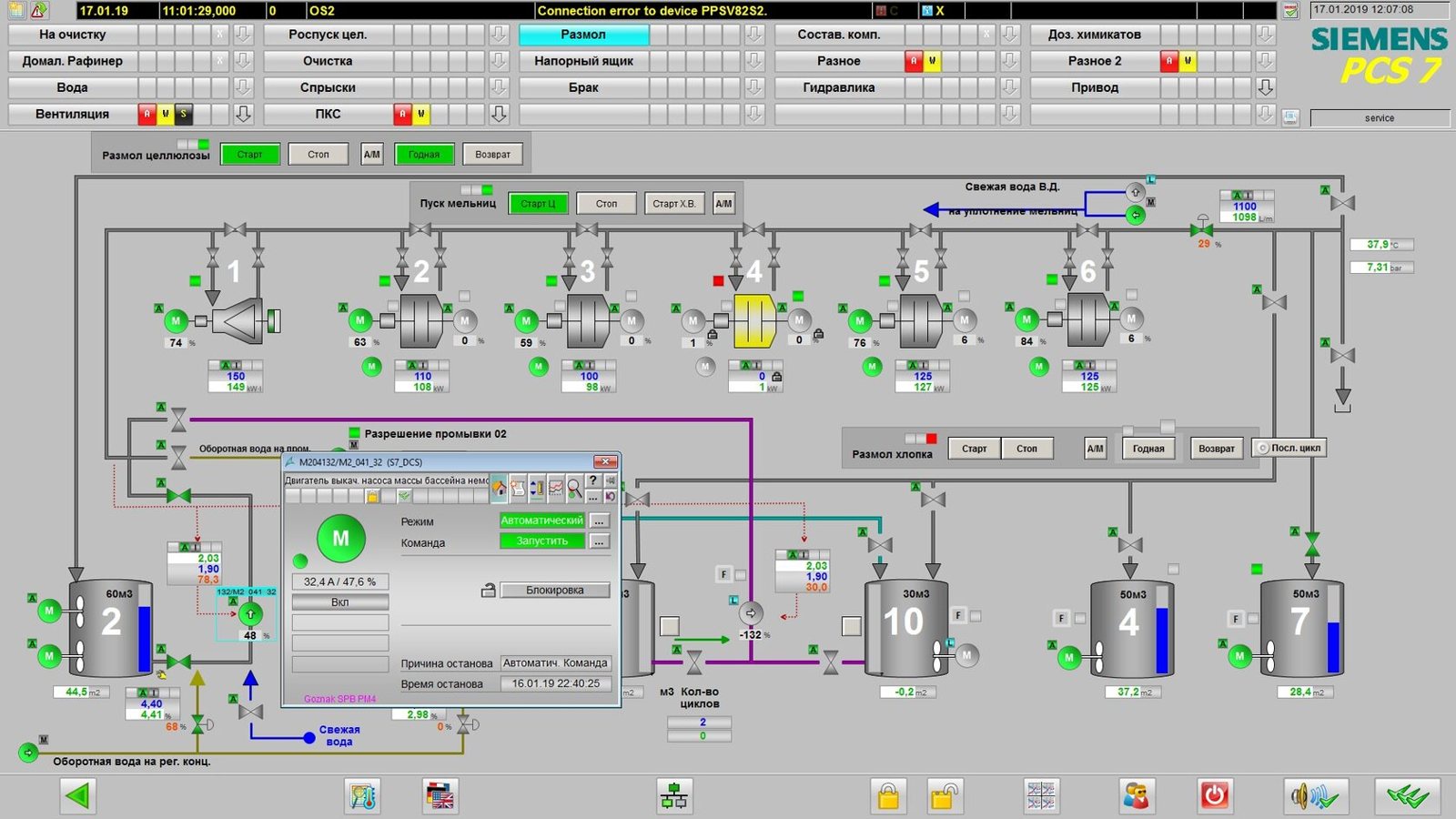
- a simulator with the mimic diagrams of the actual control system: practising start-ups, shutdowns and responses to failures
- Operating mode checks
- assessing machine behaviour under changes in steam, gas or load parameters before implementation on site
- Analytics
- information and analytical systems: collection of operating data, indicators, management reporting
- Support
- the model is updated as the equipment and the control system change
Digital twin, model and simulator: what is the difference
Under GOST R 57700.37-2021, the Russian national standard on digital twins of products, a digital twin is a system consisting of a digital model of a product and two-way information links with the product itself (where it exists) and/or its components. For a process control engineer, this means that the machine model receives data from the operating unit or its control system and returns the calculation results. A model without such a link is a calculation tool; a simulator is a model with an operator workstation.
| Solution | Connected to | Used for |
|---|---|---|
| Dynamic model of the machine | manufacturer’s and operating data | calculating transients, checking operating modes |
| Test bench with a model | unit control system controllers via I/O or a software interface | finding errors in control system algorithms before commissioning |
| Simulator | the model and operator stations with the mimic diagrams of the actual control system | operator training and practice, checking operating procedures |
| Digital twin | the model and data from the operating machine (two-way link) | comparing actual operation with calculated values, finding deviations, optimisation |
The standard distinguishes twins by product life-cycle stage: development, production and operation. Models for control system debugging and simulators are used when a machine is commissioned and while it is in service. A twin of a single machine should not be confused with a “digital twin of production” in the broad sense — a model of a whole plant that combines its machines and process lines. For more detail, see the glossary entry “Digital twin of equipment”.
How we build it
- 1
Data collection
characteristics, diagrams, manufacturer and operating experience
- 2
Model building
dynamic model of the machine and auxiliary systems
- 3
Connecting the control system
bench: controllers and operator stations work with the model
- 4
Debugging and training
checking algorithms, training operators
- 5
Support
updating the model after changes
What data are needed to create a digital twin
Three groups of data are needed: on the machine, on its control system and on its operation. The more complete the set, the fewer assumptions the model contains and the less tuning against test results it needs. We agree the list with the customer at the data collection stage.
About the machine
- manufacturer’s characteristics: for a steam turbine, the operating diagram, the flow characteristics of the steam admission valves and the steam conditions; for a compressor, the performance map at different speeds and the surge line;
- rotor moment of inertia, operating speed range and the overspeed trip setting;
- actuator data: stroke times and flow characteristics of the control and anti-surge valves;
- diagrams of the auxiliary systems: lube oil, seals, the condensing plant or the gas piping.
About the control system
- the I/O signal list with measuring ranges;
- algorithms: start-up sequences, controllers, protections and interlocks with their settings;
- operator station mimic diagrams, if a simulator is required.
About operation
- trend archives of start-ups, shutdowns and load changes;
- event logs and records of protection trips;
- test and repair reports after which the machine’s characteristics changed.
Debugging the control system on a model before commissioning
A test bench with a model moves the search for errors from commissioning to the preparation stage: algorithm errors show up in the model’s realistic transients rather than at the first start-up on site. Modelling and simulator testing before work on site is becoming a mandatory stage of the company’s projects where neither the original software nor direct support from the manufacturer is available. For example, testing of the digital model of a 2.4 MW Howden steam turbine was completed to prepare the control system for commissioning (2024).
What is checked on the bench
- the start-up sequence: permissives, warm-up, run-up and reaching the operating mode;
- speed, pressure and load controllers, under step disturbances and load rejection;
- protections and interlocks: overspeed, rotor axial displacement, low lube oil pressure;
- failures of sensors and actuators, changeover to standby;
- for compressors, anti-surge control during a rapid drop in flow.
The factory acceptance test (FAT) of the control system under IEC 62381:2024 confirms that it meets the specification before shipment. A machine model adds a check of the dynamics: how the algorithms work together with the machine. The bench does not replace commissioning and integrated testing on site; its purpose is to find and fix engineering errors earlier. Work on site is described on the installation supervision and commissioning page.
Process control simulator: integration with the control platform and model accuracy
The company develops and supplies process control simulators for industrial facilities. They reproduce the processes with the required accuracy, imitate the operation of the real facility and work in a single environment with the process control platform. Operators see the same interface as on site, so skills gained on the simulator carry over to the real machine without retraining. Training in equipment operation is described on the customer personnel training page.
Good practice is to connect the model without changing the control system configuration: the I/O is simulated externally, and the simulator runs the same application program as the site. For testing control platforms, the company has a test bench with controller, server and communication equipment and all versions of the SPPA-T3000 software available in Russia.
The required accuracy is set in the model specification. For control room simulators of fossil-fuel power plants, the benchmark is ANSI/ISA-77.20.01-2012: at steady-state full power, deviation from the reference plant’s instrument readings of no more than 2% of the measuring range, and transient times within 20%.
| Mode | Criterion |
|---|---|
| Steady state, full power | calculated values of critical parameters are stable and differ from the reference plant’s instrument readings by no more than 2% of the measuring range |
| Transients and malfunctions | parameters change in the direction expected from a best estimate of the transient, without violating physical laws |
| Alarms and protections | the simulator gives an alarm or automatic action if, and only if, the reference plant would |
| Dynamics | the characteristic time of the transient is within 20% of the reference plant under the same conditions |
For a single turbine or compressor, the level of detail is chosen to suit the task. Simple output-to-input tiebacks are enough to check the signal database and mimic diagrams. Operator training and controller tuning need a model based on mass and energy conservation equations and tuned against operating archives.
Track record
Model of a 2.4 MW steam turbine with nozzle-group governing
testing of the digital model of the 2.4 MW Howden steam turbine completed to prepare the control system for commissioning (2024)
SolutionTurbine and compressor control systems
the algorithms of new control systems are checked on machine models
ITInformation and analytical systems
business intelligence and reporting on operating data — the IT line
Power process modelling and remote monitoring
A twin of an operating machine remains useful after start-up: a discrepancy between actual and calculated parameters shows where the machine has deviated from normal. In its IT line of work, the company offers three related solutions.
- Modelling and optimisation of power processes using digital twins.
- Remote monitoring and diagnostics of turbine units. In the block diagram, the server of each turbine unit is connected through a demilitarised zone (DMZ) and a firewall, and data are sent over VPN channels to the diagnostic server. The diagnostic centre analyses the data online and advises site personnel in abnormal and emergency situations.
- Information and analytical systems: calculation of technical and economic performance indicators, collection and calculation of process data, integration of universal data buses; data analysis using data mining, predictive analytics and machine vision.
Remote access to a process control system increases risk, so the scheme includes hardware and software for securing connections and authentication, an industrial anti-virus, protection of external data channels and specialised software for secure remote access. Protection requirements are described on the cybersecurity for industrial control systems page.
Related
Questions and answers
Where do the data for the model come from?
From the manufacturer’s characteristics and documentation, the experience of its service engineers and the operating data of the specific machine.
Which machines have you modelled?
A 2.4 MW steam turbine with nozzle-group governing made by Howden; testing of the model was completed in 2024.
How is the model useful in a control system migration?
The transferred algorithms are checked on the bench with the model before the changeover on site — lower risk during commissioning.
Can a digital twin be created without the manufacturer’s documentation?
Yes, with limitations. Missing characteristics are reconstructed from operating archives and test reports, and the model is then refined against real start-ups and shutdowns. Such a twin is suitable for debugging algorithms and training, but its accuracy has to be confirmed by comparison with the machine’s data. Where neither the original software nor the manufacturer’s support is available, simulator testing before work on site is becoming a mandatory stage of the company’s projects.
Does a simulator need a real controller?
Not necessarily. The control system application program can run on a controller emulator, if the platform has one, or on a real controller on the test bench with simulated I/O. An emulator costs less and is convenient for operator training, while a real controller also allows the hardware and response times to be checked. In both cases, the operator sees the same screens as on site.
Which standards cover digital twins and simulators?
In Russia, GOST R 57700.37-2021 “Computer models and simulation. Digital twins of products. General provisions”, in force since 1 January 2022. It defines a twin as a system consisting of a digital model and two-way information links with the product. Requirements for fossil-fuel power plant simulators are set by ANSI/ISA-77.20.01-2012, and for factory and site acceptance testing of automation systems by IEC 62381:2024.
Expert in charge
Process control systemsManufacturers’ names and designations are used to identify the equipment we supply and service. Trademarks belong to their respective owners. Energy Management LLC is an independent engineering company.