
Centrifugal compressors API 617
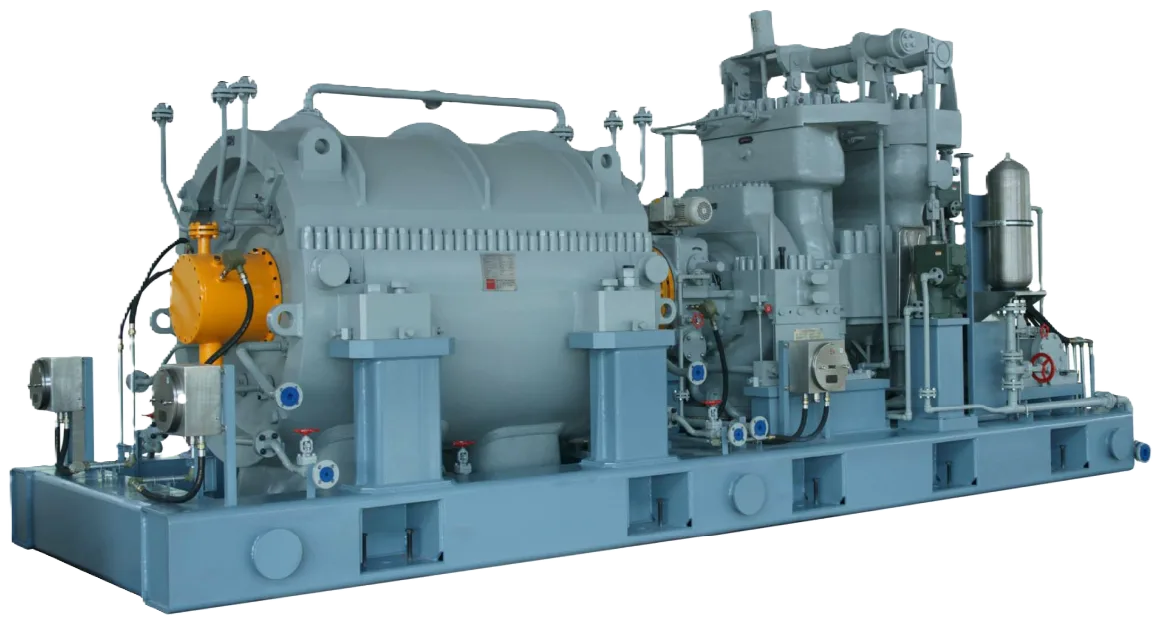
Centrifugal compressor trains to API 617 for hydrocarbons, syngas, CO₂, ammonia, ethylene, propylene, hydrogen, air and nitrogen: discharge pressure up to 15 MPa, flow up to 300,000 Nm³/h, driver power up to 30 MW, pressure ratio up to 25. Vertically or horizontally split casing; driven by a steam turbine or an electric motor.
Key facts
- Discharge pressure up to 15 MPa, flow up to 300,000 Nm³/h, pressure ratio up to 25.
- Driver power up to 30 MW — a steam turbine or an electric motor.
- Vertically split (barrel) or horizontally split casing — chosen by pressure and gas.
- Gases: hydrocarbons, syngas, CO₂, ammonia, ethylene, propylene, hydrogen, air, nitrogen.
- Built to API 617; the train sits on a common baseplate with the oil system and dry gas seals.
Data
| Parameter | Value |
|---|---|
| Discharge pressure | up to 15 MPa |
| Flow | up to 300,000 Nm³/h |
| Power | up to 30 MW |
| Pressure ratio | up to 25 |
| Casing split | vertical and horizontal |
| Driver | steam turbine or electric motor |
| Gases handled | hydrocarbons, syngas, CO₂, ammonia, ethylene, propylene, hydrogen, air, nitrogen |
| Standard | API 617 |
How a centrifugal compressor works
A centrifugal compressor compresses gas in a continuous flow. The impeller accelerates the gas from the centre outwards, the diffuser converts velocity into pressure, and the return channel guides the gas to the next impeller. The head of a stage is limited by the impeller tip speed, so the lighter the gas, the less pressure each stage adds. For high pressure ratios, the impellers are divided into sections with gas intercooling, or into several casings.
| Component | Function |
|---|---|
| Impellers on the rotor shaft | transfer the driver’s energy to the gas, raising its velocity and pressure |
| Balance piston | offsets the axial thrust created by the pressure difference across the impellers |
| Plain journal bearings and thrust bearing | locate the rotor radially and axially |
| Labyrinth and shaft end seals | limit gas leakage between stages and keep the gas inside the casing |
Design
Horizontally split
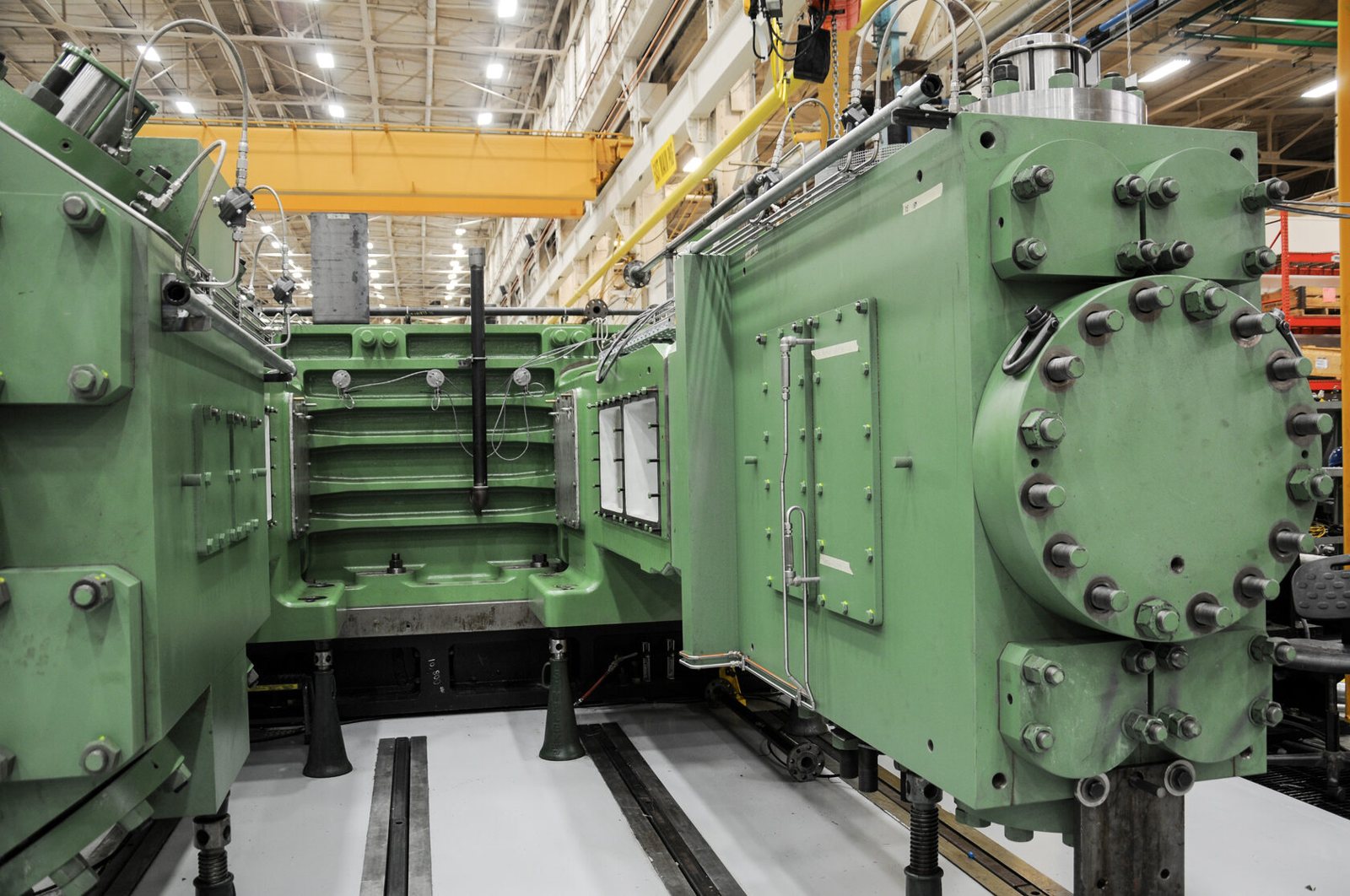
For medium pressures and large flows: the rotor lifts out upwards without dismantling the pipework — a shorter repair.
Vertically split
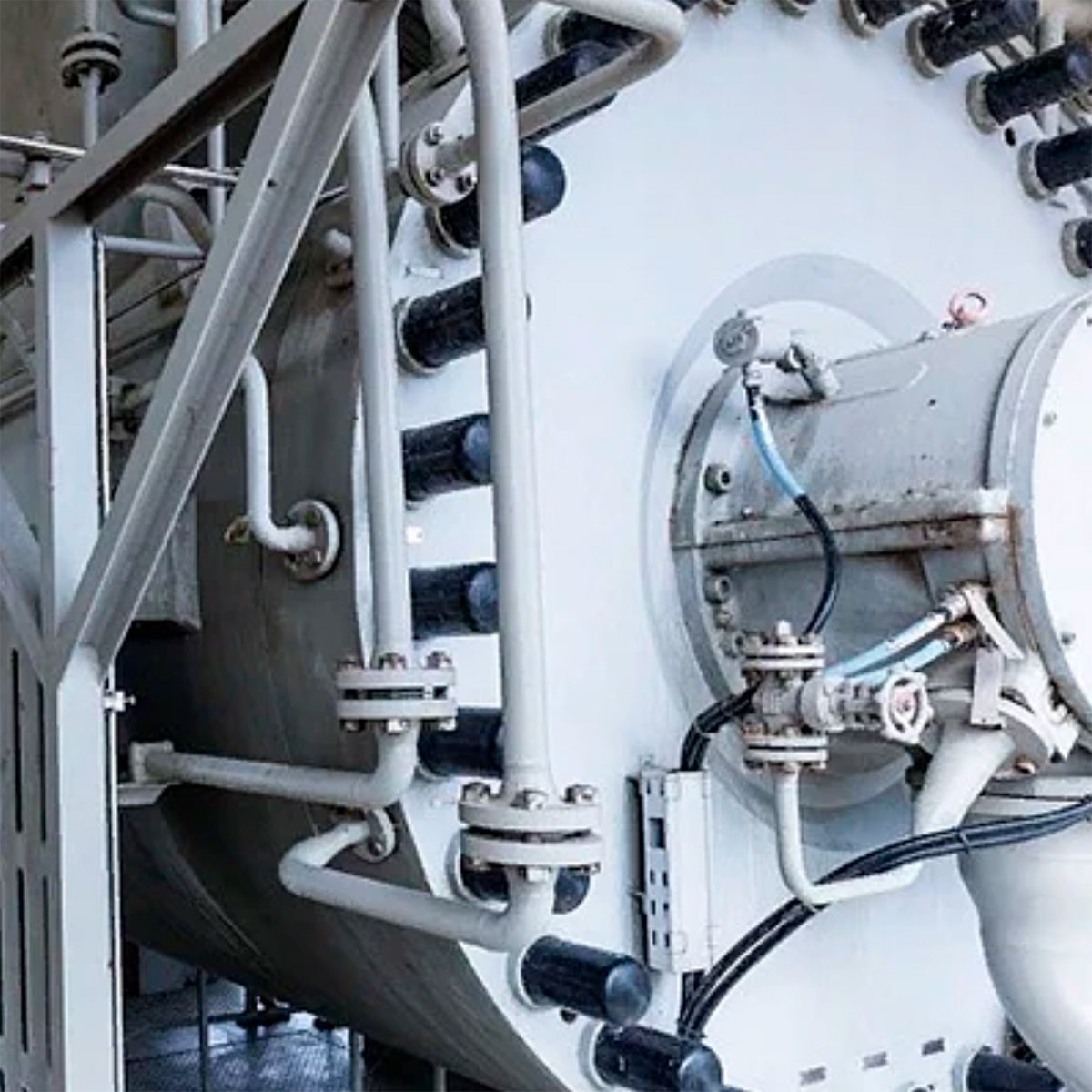
A barrel casing for high pressures and light gases, including hydrogen-bearing mixtures: tight up to 15 MPa.
Seals and systems
Dry gas seals, the oil system, anti-surge protection and vibration monitoring — all on the common baseplate of the train.
Horizontally or vertically split: how the casing is chosen
The casing split is chosen by pressure, gas molecular weight and hydrogen content.
| Feature | Horizontally split | Vertically split |
|---|---|---|
| Design | two casing halves bolted together in the plane of the shaft axis | a barrel with end covers; the internals are assembled into a bundle |
| Access to the rotor | the upper half is lifted off; with the nozzles in the lower half, the piping stays connected | the bundle with the rotor is pulled out axially without removing the process piping |
The API 617 hydrogen rule. A vertically split casing is mandatory if the hydrogen partial pressure at the casing’s maximum allowable working pressure exceeds 1,380 kPa gauge. It is calculated as the highest specified mole fraction of hydrogen multiplied by that pressure: 10 % hydrogen in a casing rated for 15 MPa gives 1.5 MPa, so a barrel casing is required. More on the hydrogen compressors page.
Shaft seals and dry gas seals
Modern trains generally use dry gas seals at the shaft ends: the rotating and stationary rings are separated by a gas film a few micrometres thick, and no oil is supplied to them. A tandem seal is usual: the first stage holds the pressure, the second backs it up, and the leakage is routed to a vent or flare. A barrier seal fed with nitrogen or air keeps bearing oil away from the gas seal. Requirements for the seals and their support systems are set by API 692 (first edition, 2018), to which API 617 refers. Selection and supply are covered on the dry gas seals page.
Applications
Processes
- feed gas and boil-off gas compression at LNG plants
- ammonia, ethylene and propylene synthesis
- hydrogen plants and reforming
- CO₂ injection and gas transport
Industries
Surge and anti-surge protection
Surge starts when the flow falls below the stable operating limit: the flow breaks down, gas briefly flows backwards, and the thrust bearing and seals take shock loads. Causes include throttling of the discharge valve, rising pressure in the downstream system, a drop in driver speed, start-ups and shutdowns.
The anti-surge system determines the operating point from flow, pressures and temperatures and, as it approaches the surge limit, opens the recycle valve from discharge to suction; under API 617 this valve must permit operation of the train in full recycle. Anti-surge protection systems are on the list of equipment the company services; how such systems work is explained under Anti-surge control.
Company experience with centrifugal compressors
- Service. We service centrifugal compressor trains rated from 750 kW to 80 MW — single-shaft and integrally geared machines by Siemens Energy, Dresser-Rand, Mitsubishi Heavy Industries, Howden, Kobelco and Hanwha (compressor service and repair).
- Inspection. In July 2023, the company’s specialists carried out a scheduled Level 1 inspection of two Siemens STC-SV (08-7-A) turbocompressors — single-shaft machines with a vertically split casing — at the condensate treatment plant of Gazprom Pererabotka LLC. The work is confirmed by a letter of appreciation from GSP Remont LLC dated 6 October 2023.
- Spare parts. For Siemens Energy STC and Dresser-Rand Datum compressors we supply dry gas, barrier and labyrinth seals, bearings, flow path parts and sensors.
- New machines. On 27 June 2024 the company received the official representative certificate of Qingdao Herui Compressor for Russia: sale of new units, installation and commissioning supervision, spare parts and service for the manufacturer’s centrifugal, reciprocating and diaphragm compressors (news on the certificate).
Manufacturer names and designations are given to identify the equipment we supply and service. Trademarks belong to their respective owners.
Related
Documents
Questions and answers
What is surge and how is the compressor protected from it?
Surge is an unstable operating mode with flow and pressure oscillations at low flow. Protection comes from an anti-surge system: a recycle valve and a controller that keep the operating point to the right of the surge line. <a href="../../../en/knowledge/glossary/compressor-surge/index.html">More in the glossary.</a>
What drives a centrifugal train?
A <a class="term-link" href="../glossary/steam-turbine/index.html" title="What is a steam turbine">steam turbine</a> or an electric motor, through a gearbox where required; driver power is up to 30 MW.
When is a vertically split casing chosen?
At high pressure and with light gases — hydrogen and hydrogen-bearing mixtures: the barrel casing is tighter and is rated for pressures up to 15 MPa.
What data are needed for the calculation?
Gas composition, inlet pressure and temperature, the required discharge pressure and flow, the type of driver and the site climate. Fill in the enquiry <a class="term-link" href="../glossary/data-sheet/index.html" title="What is a data sheet">data sheet</a> online or send us your specification.
Which tests does a centrifugal compressor pass under API 617 before shipment?
Mandatory tests: a hydrostatic test of the casing at no less than 1.5 times the maximum allowable working pressure, an overspeed test of each impeller at no less than 115 % of maximum continuous speed, dry gas seal tests to API 692 and a four-hour mechanical run at maximum continuous speed with checks of vibration, bearings and seal leakage. For toxic, hazardous or flammable gases, the assembled compressor is then leak-tested with inert gas to check the casing and its joints. Shaft vibration is limited to 25.4 µm peak to peak, less above 12,000 rpm. A performance test to ASME PTC 10 or ISO 5389 is run if ordered.
Sources and standards: data from the company; requirements for centrifugal compressors per API 617 (9th edition, 2022), for dry gas seals per API 692 (1st edition, 2018).
Expert in charge
Rotating equipment service