
Screw compressors API 619
Screw compressors to API 619: discharge pressure up to 1.3 MPa at atmospheric suction, flow up to 1,070 m³/min, driver power up to 1.8 MW. Oil-free and oil-injected designs, packaged on a common skid. For hydrocarbons, air and process gases.
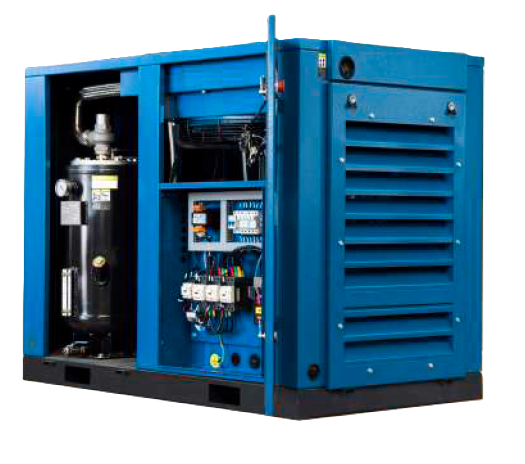
Key facts
- Discharge pressure up to 1.3 MPa; atmospheric suction.
- Flow up to 1,070 m³/min, driver power up to 1.8 MW.
- Oil-free (dry) and oil-flooded designs.
- Modular packaging: compressor, driver, coolers and control system on one skid.
- Gases: hydrocarbons, air, process gases.
- API 619 — rotary-type positive-displacement compressors for petroleum, petrochemical and natural gas industries.
Specifications
| Parameter | Value |
|---|---|
| Discharge pressureMPa | up to 1.3 (atmospheric suction) |
| Volume flowm³/min | up to 1,070 |
| PowerMW | up to 1.8 |
| Design | oil-free and oil-flooded; modular |
| Gases handled | hydrocarbons, air, process gases |
| Standard | API 619 |
Design features
- Principle
- two screw rotors — male and female — compress the gas in shrinking cavities between the lobes and the casing
- Oil-free design
- the rotors do not touch and are synchronised by timing gears; the gas has no contact with oil
- Oil-flooded design
- oil is injected into the compression cavity to seal, cool and lubricate; an oil separator follows the discharge
- Capacity control
- slide valve, suction throttling or variable-speed drive
- Seals
- mechanical or labyrinth — depending on the gas
- Driver
- electric motor, through a gearbox where required
Oil-free or oil-flooded: how to choose
The design is chosen according to the gas. An oil-free screw compressor is needed when the gas must not be contaminated with oil, and also when it is dirty, varies in composition or tends to polymerise. An oil-flooded machine is for clean gases compatible with the oil, where a high pressure ratio in a single stage and smooth capacity control matter.
| Criterion | Oil-free (dry) | Oil-flooded |
|---|---|---|
| Oil and gas | no contact: oil is present only in the bearings and timing gears, which shaft seals separate from the gas | oil is injected into the compression chamber and separated downstream of the compressor; traces remain in the gas, typically a few ppm |
| Pressure ratio per stage | limited by the discharge temperature; a higher ratio needs two stages with intercooling or liquid injection | higher: the oil removes the heat of compression |
| Capacity control | speed variation, bypass, suction throttling | slide valve, stepless, typically from 15–20 to 100 % of capacity; speed variation |
| Typical gases | dirty and dusty gases, gases of variable composition, polymerising gases; refinery off-gas | clean gases compatible with the oil: fuel gas, hydrogen, helium |
| What to check | shaft seals, noise and pressure pulsations: silencers are needed | oil and gas compatibility: heavy hydrocarbons dissolve in the oil and reduce its viscosity |
Both designs are positive-displacement machines: they are not subject to surge, and their capacity depends little on the discharge pressure. This sets a screw compressor apart from a centrifugal compressor, which has the advantage at high flows.
Applications
Duties
- compressed air for production
- hydrocarbon gas compression: fuel gas, associated gas, flare gas recovery
- process gases on industrial sites
- continuous operation with variable gas composition and contamination
What API 619 requires
API 619 is the standard for special-purpose screw compressors in the petroleum, petrochemical and natural gas industries: oil-free and oil-flooded, for vacuum, pressure or both. The current 5th edition, dated December 2010, is identical to ISO 10440-1:2007; API has reaffirmed it without changes. General-purpose air compressors are outside its scope; packaged oil-free air compressors are covered by ISO 10440-2.
Special-purpose means continuous operation in critical service, usually without a spare. For this reason, an API 619 machine is designed for a service life of at least 20 years and at least 3 years of uninterrupted operation. The standard sets requirements for:
- shaft seals, rotor dynamics and bearings;
- lube-oil and seal-oil systems, to ISO 10438 (API 614);
- couplings, gear units, machinery protection systems and explosion protection, with references to ISO 10441 (API 671), ISO 13691 (API 613), API 670 and IEC 60079;
- silencers for oil-free machines, shop testing and vendor documentation.
Decisions and information that the standard leaves to the purchaser are marked with a bullet (•): they are entered in its data sheets (Annex A) or stated in the enquiry. The vendor lists any variations from the standard in the proposal, and they affect the scope of supply.
What is needed to select a screw compressor
A screw compressor is selected from an enquiry data sheet. The limits in the specification table mark the boundaries of the range, not the data of a single machine: compressing 1,070 m³/min of gas from atmospheric pressure to 1.3 MPa takes at least 4.6 MW even in an ideal isothermal process, against the 1.8 MW limit. Pressure, flow and power are therefore selected together.
What to state in the data sheet
- gas composition in mole fractions, including hydrogen sulphide, moisture, heavy hydrocarbons, liquid and solids;
- suction pressure and temperature: minimum, normal and maximum;
- discharge pressure and flow, with the conditions the flow refers to: at suction (m³/min) or normal conditions (Nm³/h);
- the permissible oil content of the gas;
- the turndown range and frequency of starts;
- the driver, cooling, installation, climate and hazardous area classification;
- whether an API 619 design is required.
From these data we select the compressor and prepare a technical and commercial proposal. If the compressor is to supply fuel gas to a gas turbine, attach the turbine manufacturer’s requirements for gas pressure, temperature and cleanliness.
Related
Documents
Sources and standards: the data come from the company’s current website; requirements are set by API 619 (rotary-type positive-displacement compressors for petroleum, petrochemical and natural gas industries).
Questions and answers
How does an oil-free screw compressor differ from an oil-flooded one?
In the oil-free machine the <a class="term-link" href="../glossary/rotor/index.html" title="What is the rotor of a turbine or compressor">rotors</a> are synchronised by timing gears and do not touch, and the gas has no contact with oil — for instrument air and gases that must not be contaminated with oil, as well as for dirty and polymerising gases. In the oil-flooded machine oil is injected into the compression cavity to seal and cool the gas; such a compressor is simpler and gives a higher pressure ratio per stage.
What pressure does a screw compressor deliver?
Up to 1.3 MPa at atmospheric suction pressure, which is the limit of the range. If the gas arrives at elevated pressure, whether a design is feasible and what discharge pressure it gives are determined from the data sheet: they are limited by the permissible differential pressure across the rotors and the casing design pressure.
What does the modular package include?
Compressor, driver, oil system, coolers, separator, control system and acoustic enclosure on one skid — the unit is connected to the site utilities.
How are screw compressors serviced?
The scope and intervals of work are set by the manufacturer’s manual. On oil-flooded machines, the oil is changed based on oil analysis, and the filters and oil separator elements based on differential pressure or running hours. On oil-free machines, the timing gears and shaft seals are checked. On both designs, the bearings, rotor clearances and vibration are checked.
Does a screw compressor need anti-surge protection?
No. Surge is unstable operation of dynamic compressors, whereas a screw compressor is a positive-displacement machine. It needs other protections: on discharge pressure and temperature, differential pressure across the rotors, oil pressure and temperature, and vibration. A relief valve is fitted on the discharge: against a closed valve, a positive-displacement compressor keeps delivering gas and the pressure rises above the permissible level.
Expert in charge
Rotating equipment serviceManufacturers’ names and designations are used to identify the equipment we supply and service. Trademarks belong to their respective owners. Energy Management LLC is an independent engineering company.