
Live-tank SF6 circuit breakers 3AP1 FG and 3AP2 FI, 110–500 kV
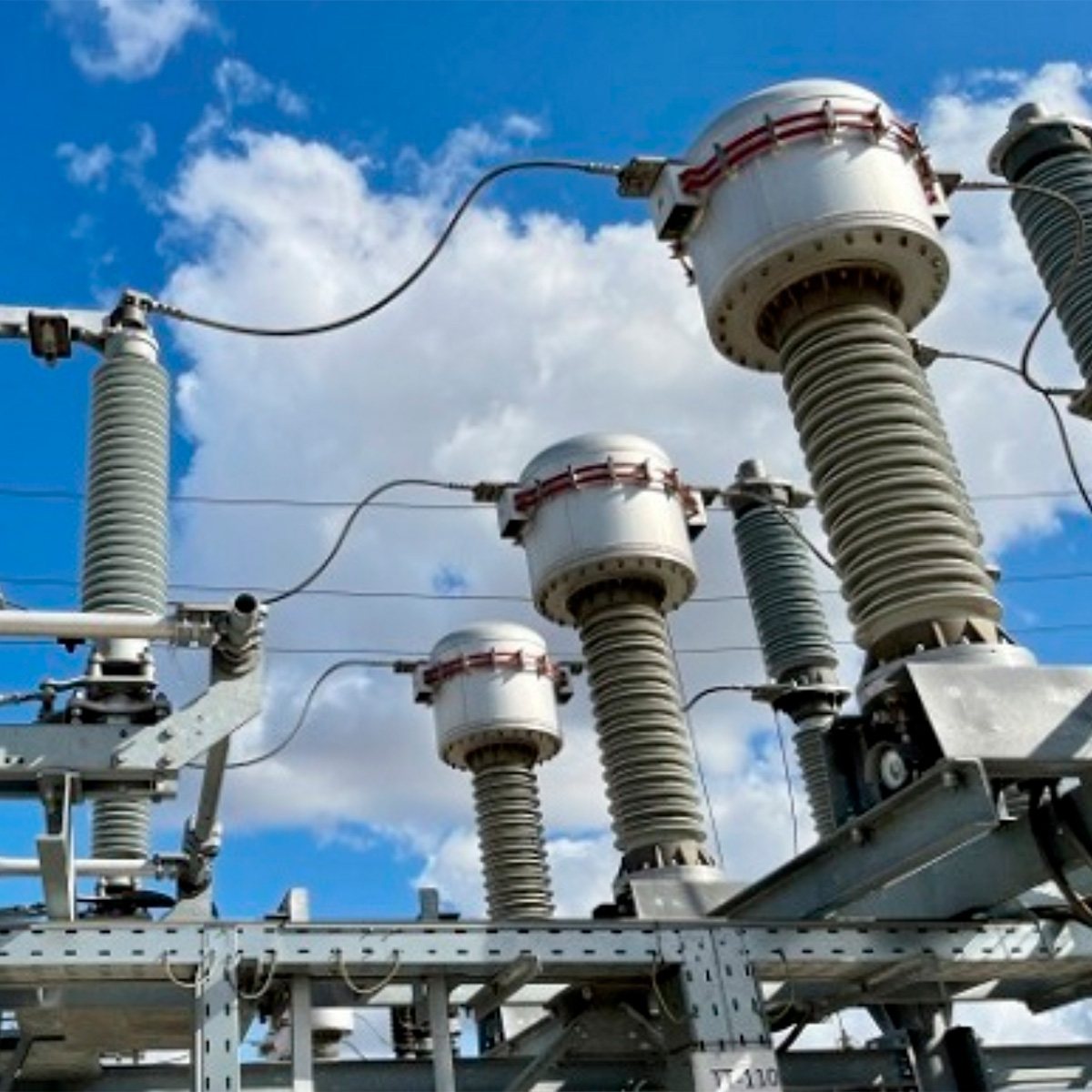
Outdoor live-tank SF6 circuit breakers: 3AP1 FG for 110–220 kV (72.5–245 kV rated voltage) and 3AP2 FI for 330–500 kV (362–550 kV). Rated current up to 5,000 A, breaking current up to 63 kA, three-pole and single-pole designs, spring-operated mechanism, operation from −60 to +55 °C. The assembly plant for dead-tank and live-tank breakers can produce up to 350 units a year.
Key facts
- Two series: 3AP1 FG for 110–220 kV networks and 3AP2 FI for 330–500 kV networks.
- Rated current 2,500–5,000 A, breaking current 31.5–63 kA.
- Three-pole design with a common operating mechanism and single-pole design with a mechanism per pole.
- Interrupter with minimum operating energy; spring-operated mechanism.
- Operating temperature range from −60 to +55 °C.
- Assembly plant for dead-tank and live-tank breakers — up to 350 units a year; the service centre supports the equipment throughout its service life.
Range
| Series | Rated voltage, kV | Rated current, A | Breaking current, kA |
|---|---|---|---|
| 3AP1 FG | 72.5 | 2,500 | 31.5 |
| 3AP1 FG | 145 | 4,000 | 40 |
| 3AP1 FG | 245 | 4,000 | 50 |
| 3AP2 FI | 362 | 5,000 | 63 |
| 3AP2 FI | 550 | 5,000 | 63 |
Design features
- Pole
- a support insulator column with the interrupter unit on top; live parts and the interrupter are in SF6
- Interrupter
- arc quenching with minimum operating energy — lower mechanical load on the mechanism and less wear
- Operating mechanism
- spring-operated: closing and opening energy is stored in springs, which are charged by an electric motor
- Design
- three-pole with a common mechanism (3AP1 FG) and single-pole with a mechanism per pole — for single-phase operation
- Climate
- operation from −60 to +55 °C — including northern sites
- Monitoring
- SF6 density monitoring; integration into the substation control system — on request
How a live-tank breaker quenches the arc
The operating mechanism at the base of the column moves the moving contact of the interrupter unit through an insulating rod. Opening takes place as follows:
- The main contacts part, and the current commutates to the arcing contacts.
- The arcing contacts separate, and an arc is drawn.
- When an operating current is interrupted, the moving contact cylinder compresses the SF6 gas and directs it through the nozzle onto the arc. With a short-circuit current, the arc itself raises the pressure by heating the gas.
- At current zero the arc goes out, and the SF6 gas restores the dielectric strength of the gap.
The arc provides the energy needed to interrupt high currents (the self-compression principle), and the mechanism only has to move the contacts — so a spring-operated mechanism is sufficient. The 3AP1 FG has one interrupter unit per pole; the 3AP2 FI for 362 and 550 kV has two interrupter units connected in series. In the designation, G stands for a common mechanism and a common base for all three poles, and I for a separate mechanism and support for each pole.
Up to 350 circuit breakers a year
Assembly of dead-tank and live-tank SF6 circuit breakers, acceptance tests, installation supervision and adjustment at the substation. The service centre supports the breakers throughout their service life: diagnostics, mechanism maintenance, SF6 handling, repairs.
Tests at commissioning and in service
Before energisation, the breaker undergoes acceptance tests under clause 1.8.21 of the Russian Electrical Installation Code (PUE, 7th edition). The checks cover:
- insulation resistance of secondary circuits and DC resistance of the main circuit;
- the breaker insulation — with a power-frequency high-voltage test;
- minimum operating voltage and the characteristics stated in the manufacturer’s data sheet, such as closing and opening times;
- operation under repeated closing and opening trials;
- gas tightness and SF6 moisture content — a dew point no higher than −50 °C;
- voltage grading capacitors — on poles with two interrupter units, where such capacitors are fitted.
Tests of SF6 circuit breakers are among those permitted to the company’s high-voltage test laboratory under registration certificate No. 9834 of 20 December 2024. Once the breaker is in service, the service contract provides for a diagnostic survey and maintenance without pumping out the SF6 gas, on request or after 12 years, and complex repair at the works, on request or after 25 years. See the high-voltage equipment service page for details.
Applications
Where they are installed
- outdoor switchyards of 110–500 kV substations
- line, transformer and shunt reactor bays
- switchyard refurbishment replacing air-blast and oil circuit breakers
- substations of power plants and industrial enterprises
Live-tank or dead-tank: when each makes sense
The first criterion is where the current transformers are. A live-tank breaker has no built-in ones, so it suits bays where the design provides for stand-alone current transformers. The next step is to compare ratings from the series data tables:
- Rated current. At 145 kV the live-tank 3AP1 FG is rated at 4,000 A, the dead-tank 3AP1 DT at 3,150 A. At 362 and 550 kV the live-tank 3AP2 FI is rated at 5,000 A, the dead-tank breakers at 4,000 A. At 245 kV both are rated at 4,000 A, while at 72.5 kV the dead-tank breaker is rated higher: 3,150 A against 2,500 A.
- Breaking current. At 245 kV the dead-tank 3AP1 DT has 63 kA and the live-tank 3AP1 FG 50 kA; at 72.5 kV, 40 and 31.5 kA. At 145, 362 and 550 kV the two series have equal ratings.
- Weight and SF6. A live-tank pole is lighter than a dead-tank one and holds less gas, which makes transport and installation simpler and means less SF6 to fill, monitor and recover.
A dead-tank breaker is more appropriate where built-in current transformers are needed, and where the short-circuit current in a 220 kV network exceeds 50 kA. Ratings are on the dead-tank breakers 3AP1 DT and 3AP2 DT page.
Related
Documents
Source: the range and data come from the company’s current website. 3AP designations are the manufacturer’s type designations.
Questions and answers
How does a live-tank breaker differ from a dead-tank one?
In a live-tank breaker the interrupter sits on an insulator column at line potential; in a dead-tank breaker it is inside an earthed tank into which <a class="term-link" href="../glossary/current-transformer/index.html" title="What is a current transformer">current transformers</a> are built. The live-tank design is more compact and lighter; the dead-tank design suits sites that need built-in CTs and high seismic withstand.
What does the single-pole design mean?
Each pole has its own operating mechanism: single-phase operation and single-phase auto-reclosing are possible. The three-pole design with a common mechanism is simpler and cheaper.
Does the breaker work at −60 °C?
Yes, the operating range is from −60 to +55 °C — the breakers are designed for northern sites as well.
Which live-tank breaker is needed for a 220 kV network?
The 3AP1 FG rated 245 kV, the IEC highest voltage for the 220 kV class: rated current 4,000 A, breaking current 50 kA. If the short-circuit current at the point of installation exceeds 50 kA, the series data tables point to the dead-tank 3AP1 DT rated 63 kA.
Expert in charge
High-voltage equipmentManufacturers’ names and designations are used to identify the equipment we supply and service. Trademarks belong to their respective owners. Energy Management LLC is an independent engineering company.