
Service for high-voltage equipment 110–750 kV
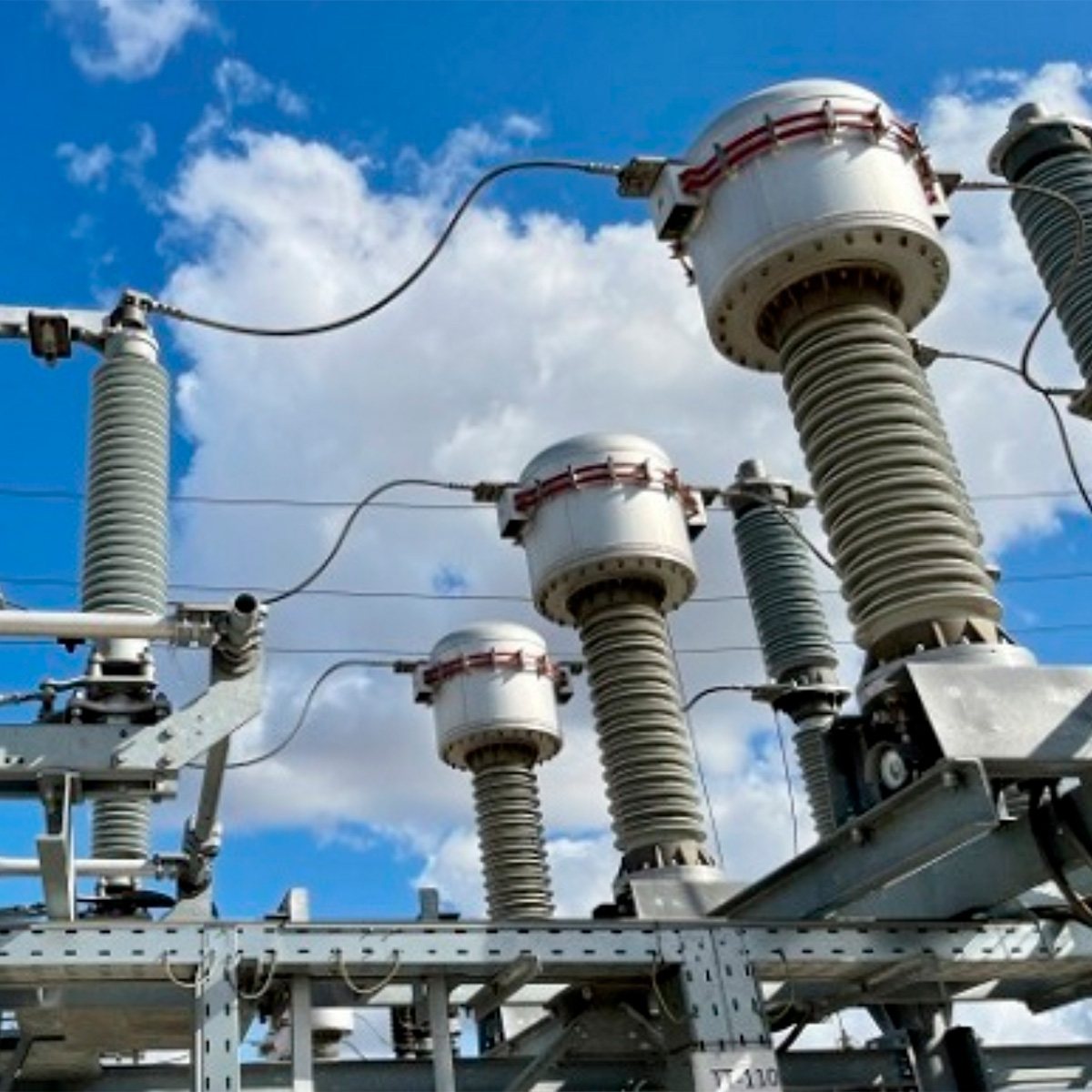
We service GIS, SF6 circuit breakers, disconnectors and earthing switches, current and voltage transformers and surge arresters rated 110–750 kV: preliminary inspection, diagnostic survey, maintenance without pumping out the SF6, complex repair at the works, emergency stock, upgrades, installation supervision and training. Testing is done by our own test laboratory up to 750 kV. We operate in Russia, Belarus, Kazakhstan and Uzbekistan.
Key facts
- Nine services under the service contract: from the preliminary inspection to personnel training.
- Maintenance on request or after 12 years, without pumping out the SF6 or opening the breakers; complex repair on request or after 25 years, at the works.
- The emergency stock is built up and replenished over the term of the contract.
- Testing and measurement are done by our own test laboratory with two resonant test systems up to 750 kV.
- Track record: 1,920 GIS sets at the 220 kV TsRP substation (Rosseti).
Scope of services
| № | Service | Interval | Note |
|---|---|---|---|
| 1 | Preliminary inspection of the equipment | once, when the contract is signed | condition assessment and entry in a single database |
| 2 | Diagnostic survey | on request or after 12 years | condition assessment before maintenance |
| 3 | Maintenance (simple repair) | on request or after 12 years | without pumping out the SF6 or opening the breakers |
| 4 | Complex repair | on request or after 25 years | at the works, with the SF6 pumped out and the breaker dismantled |
| 5 | Consultancy | over the term of the contract | in abnormal situations |
| 6 | Building up and replenishing the emergency stock | over the term of the contract | for rapid fault clearance |
| 7 | Equipment upgrades | on request | to improve equipment performance |
| 8 | Installation supervision for new equipment | under a separate contract | can be carried out together with the supply |
| 9 | Training of the customer's personnel | under a separate contract | under an agreed programme |
What each stage of service involves
The stages of the contract build up step by step: from an inspection to a repair at the works with dismantling. The scope of each stage is set by the manufacturer’s operating manual and by the test standards; the table shows the typical scope of work for dead-tank and live-tank SF6 circuit breakers and GIS.
| Stage | What is checked and done | Where |
|---|---|---|
| Preliminary inspection | visual inspection of the insulation, enclosures and operating mechanism cabinets; readings of the SF6 density monitors and operation counters; check against nameplate data; entry of each apparatus in a single database | on site |
| Diagnostic survey | DC resistance of the main circuit, closing and opening times, minimum operating voltage of the closing and tripping coils, SF6 moisture content by dew point, gas tightness; for GIS, the partial discharge level | on site |
| Maintenance (simple repair) | checking, adjusting and lubricating the operating mechanisms, replacing worn parts outside the gas compartment, checking secondary circuits and density monitors, check measurements after the work | on site |
| Complex repair | SF6 pumped out, breaker dismantled, worn interrupter parts, seals and adsorbent replaced, reassembly, SF6 filling, moisture and tightness checks, tests | at the works |
After installation, or after a repair affecting the main-circuit insulation, GIS is tested with AC withstand voltage and partial discharge monitoring (STO 34.01-23.1-001-2017, clause 19.3). On site, these tests are carried out by the company’s high-voltage test laboratory: see high-voltage testing of GIS and circuit breakers.
Emergency stock and upgrades
The emergency stock is a set of spare parts tailored to a specific equipment fleet: parts and assemblies that allow an apparatus to be restored after a failure without waiting for them to be manufactured and delivered. Its content depends on the fleet: the types and number of apparatus, their operating time and the results of inspections and diagnostics.
A GIS upgrade may include integrating digital control systems and additional monitoring, such as partial discharge sensors and voltage presence sensors. The decision to upgrade is usually based on the results of a diagnostic survey.
Equipment we service
How the work runs
- 1
Enquiry
Type of equipment, voltage class, site.
- 2
Preliminary inspection
Condition assessment, entry in a single database.
- 3
Work programme
Diagnostics, maintenance or repair — by condition and running hours.
- 4
Execution
On site or at the works; testing by the test laboratory.
- 5
Report
Records, defect lists and a plan for the next round of work.
Long-term service contract
The service contract is designed to support the equipment throughout its service life. The results of the preliminary inspection serve as the baseline: together with the intervals in the table of services, they are used to plan diagnostics, maintenance and repair.
What the cost depends on. Prices are not published on the website; the cost is calculated for each service request. The main factors are:
- the number and types of apparatus and their voltage classes;
- the scope of scheduled work in each year of the contract;
- whether a complex repair at the works and transport of the apparatus are needed;
- the content of the emergency stock;
- testing by the test laboratory after the work;
- the location of the site and the procedure for admitting personnel.
What to include in a service request
The more complete the initial data, the more accurate the work programme. A request should ideally include:
- the type of apparatus, manufacturer, model designation and year of manufacture;
- the voltage class, rated current and breaking current;
- the number of apparatus or GIS bays at the site;
- the commissioning date, number of switching operations and most recent repairs;
- the results of the latest measurements and tests, if available;
- in the event of a fault, what happened and which alarms and trips were recorded;
- the site address and the procedure for admitting personnel.
If equipment has failed, use the urgent request at the top of the page.
Testing up to 750 kV
Insulation withstand testing with partial discharge measurement is done with the mobile resonant test systems WRV 3.6/680 M and WRV 1.5/680 G; insulation resistance and circuit breaker timing are measured with separate laboratory instruments.
Test and SF6 handling standards
The scope of measurements and the permissible values are taken from the manufacturer’s operating manual and from industry standards. The main documents are:
| Document | What it covers |
|---|---|
| PUE (Russian Electrical Installation Code), 7th edition, clause 1.8.21 | acceptance tests of SF6 circuit breakers: main circuit resistance, breaker characteristics, gas tightness, SF6 moisture content |
| STO 34.01-23.1-001-2017 (Rosseti PJSC) | frequency, scope and standards for testing electrical equipment of power plants and grids, including GIS |
| GOST R 52565-2006 | general specifications for AC circuit breakers rated 3–750 kV |
| GOST R 54828-2022 | general specifications for GIS rated 110 kV and above |
| IEC 62271-4:2022 | handling of SF6 and other insulating gases during installation, repair and decommissioning |
| IEC 60480:2019 | specifications for re-using SF6 after recovery |
The company’s high-voltage test laboratory is registered with Rostechnadzor: certificate No. 9834 of 20 December 2024. The permitted tests include GIS, SF6 circuit breakers, disconnectors and current and voltage instrument transformers. More on checking GIS insulation is on the partial discharge measurement page.
Projects
Rosseti — MES of Siberia · 220 kV TsRP substation
1,920 sets of GIS equipment
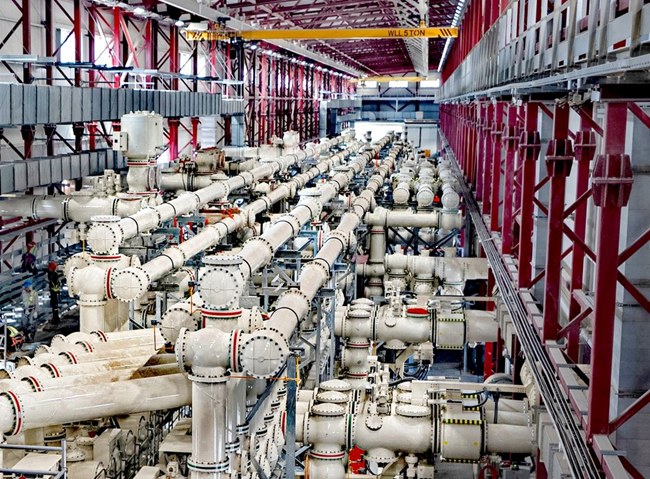
Akkuyu NPP
400 kV GIS · 400 kV SF6 bus ducts
Emergency repair and testing at nuclear power plants
Besides the TsRP project, the company’s specialists have worked on high-voltage equipment at nuclear power plants. The customers recognised this work in letters of appreciation.
- Novovoronezh NPP-2, October 2025. From 23 to 30 October the company’s specialists, together with the plant’s repair staff, carried out emergency repair work to replace a circuit breaker at the 500 kV Donskaya substation of unit 2. By the end of the repair, high-voltage test equipment had been delivered to the plant; the tests confirmed the quality of the work. The plant’s letter reads: “Effective action in repairing the 500 kV switchgear made it possible to avoid downtime of the main equipment and to prevent any reduction in power output” (translated from Russian).
- Akkuyu NPP, Turkey, 2025. High-voltage tests with partial discharge measurement of the 400 kV GIS, followed by tests of the 400 kV GIS and 400 kV SF6 bus ducts during the energisation of the right-hand section of the GIS. Akkuyu Nuclear JSC sent letters of appreciation dated 4 November and 22 December 2025.
Scans of the letters are published in the letters of appreciation section.
Service centre for 110–500 kV equipment
In April 2024 the company and St Petersburg New Energy Group LLC (SNEG) signed a cooperation agreement and set up a service centre for the assembly, installation, adjustment and maintenance of 110–500 kV equipment: air-insulated switchgear and GIS. SNEG has the resources to supply equipment, while Energy Management contributes its competence in servicing high-voltage equipment from various manufacturers. The partners announced that they would form a comprehensive supply and service offering for customers in Russia, Belarus and Central Asia.
Questions and answers
What are simple and complex repairs?
A simple repair is <a class="term-link" href="../glossary/maintenance-and-overhaul/index.html" title="What is maintenance, medium and major overhaul">maintenance</a> on site without pumping out the SF6 or opening the breakers. A complex repair is done at the works, with the SF6 pumped out and the breaker dismantled.
What does the emergency stock include?
A set of parts and assemblies for rapid fault clearance, built up and replenished over the term of the contract.
How quickly do you respond to a fault?
Response and call-out times are agreed with the customer for each request and kept as short as possible.
Do you service equipment made by other manufacturers?
Yes. The company services 110–750 kV high-voltage equipment from various manufacturers: <a class="term-link" href="../glossary/gis/index.html" title="What is GIS (gas-insulated switchgear)">GIS</a>, SF6 circuit breakers, disconnectors and earthing switches, current and voltage transformers and surge arresters.
How does a diagnostic survey differ from maintenance?
A survey consists of measurements without repair: main circuit resistance, closing and opening times, SF6 moisture content, gas tightness and, for GIS, partial discharge. It shows the condition of the apparatus before maintenance. Maintenance is actual work: adjusting and lubricating the operating mechanisms, replacing worn parts outside the gas compartment, and checking secondary circuits and density monitors.
Do you carry out emergency repairs of SF6 circuit breakers?
Yes. For example, in October 2025 the company’s specialists, together with the plant’s repair staff, carried out emergency repair work to replace a circuit breaker at the 500 kV Donskaya substation of Novovoronezh NPP-2. After the repair the equipment underwent high-voltage tests, which confirmed the quality of the work.
What happens to the SF6 during a complex repair?
The SF6 is pumped out before the breaker is dismantled. IEC 62271-4 sets the gas handling procedures and IEC 60480 sets the requirements for re-using the gas. After reassembly the apparatus is filled with SF6 and checked for moisture content and gas tightness.
Engineering team
High-voltage equipment