
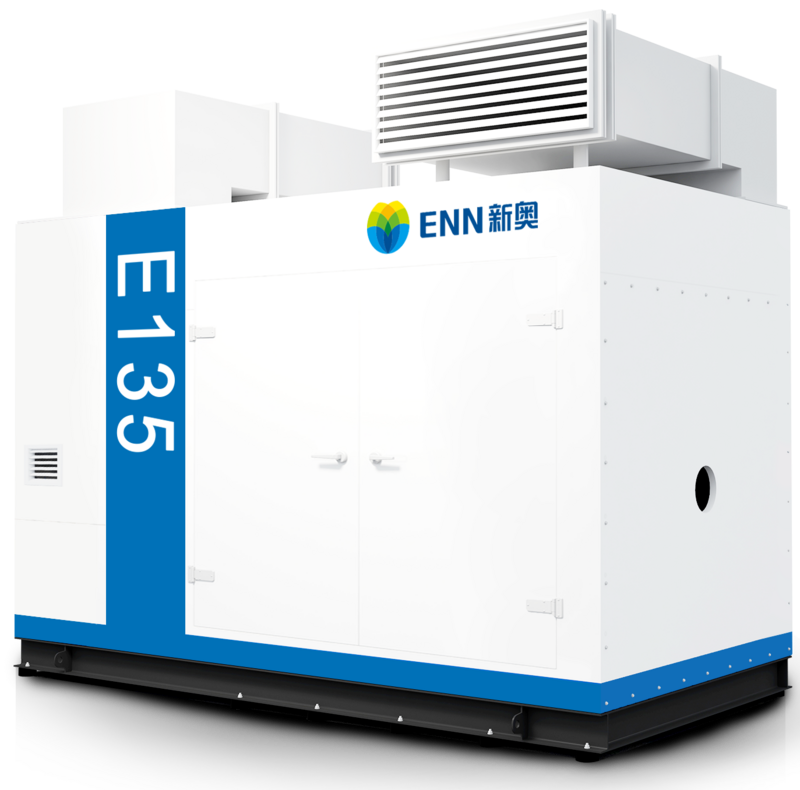
110–128 kW
Series 135
The base machine, in commercial operation since 2018, with more than 130,000 running hours and no reported faults.
- Simple cycle
- 128 kW · steam 0.8 t/h
- Recuperated
- 110 kW · fuel 51 Nm³/h
An efficient, reliable and clean solution for distributed power supply and waste heat recovery. Small size and weight, mobility, scalability, operation on different fuels, low noise and emissions, long intervals between service visits and remote monitoring. Three series — 135, 390 and 2100 — in simple cycle and with a recuperator.
The base machine, in commercial operation since 2018, with more than 130,000 running hours and no reported faults.
The scaled-up machine.
The turbine and generator are based on series 390; the machine runs on a range of fuels, including waste gases from industrial processes.
| Parameter | 135simple cycle | 135recuperated | 390simple | 390recuperated | 2100simple | 2100recuperated |
|---|---|---|---|---|---|---|
| Rated outputkW | 128 | 110 | 396 | 346 | 1,966 | 1,721 |
| Exhaust gas temperature°C | 604 | 308 | 592 | 308 | 578 | 320 |
| Exhaust gas flowkg/s | 1.17 | 1.14 | 2.90 | 2.85 | 11.9 | 11.6 |
| Fuel gas consumptionNm³/h | 103 | 51 | 255 | 143 | 1,075 | 626 |
| NOx emissions | ≤ 25 ppm (50 mg/m³) | the same | the same | the same | the same | the same |
| Noise leveldB(A) | ≤ 85 | ≤ 85 | ≤ 85 | ≤ 85 | ≤ 85 | ≤ 85 |
| Steam outputt/h | 0.8 | — | 1.9 | 0.6 | 7.7 | 2.7 |
| Dimensionsmm | 3,200 × 2,202 × 3,460 | 5,536 × 2,202 × 3,410 | 5,200 × 2,500 × 4,709 | 8,189 × 2,500 × 4,709 | 8,000 × 2,420 × 3,331 (without the air intake) | 8,000 × 2,420 × 3,331 (without the air intake and recuperator) |
| Weightt | 7.4 | 8.1 | 16 | 17.5 | 30 | 40 |
A microturbine is a low-output gas turbine. It runs on the same cycle as large gas turbine units: the compressor compresses ambient air, gas is burnt in this air in the combustor, and the hot gases expand in the turbine. The turbine drives the compressor and the generator, and the exhaust goes to heat recovery. Microturbines have a lower pressure ratio and combustion temperature than large machines, so without a recuperator their electrical efficiency is modest.
A recuperator is a gas-to-air heat exchanger: the turbine exhaust preheats the compressed air before the combustor, so less gas is needed for the same heating. The price is additional pressure loss on the air and exhaust sides: according to the data table, output with a recuperator is 12–14% lower than in simple cycle, and the exhaust leaves cooler, so it raises less steam.
| Series | Output, kW | Gas consumption, Nm³/h | Specific gas consumption, Nm³/kWh | Exhaust, °C | Steam, t/h |
|---|---|---|---|---|---|
| 135 | 128 → 110 (−14%) | 103 → 51 (−50%) | 0.80 → 0.46 | 604 → 308 | 0.8 → — |
| 390 | 396 → 346 (−13%) | 255 → 143 (−44%) | 0.64 → 0.41 | 592 → 308 | 1.9 → 0.6 |
| 2100 | 1,966 → 1,721 (−12%) | 1,075 → 626 (−42%) | 0.55 → 0.36 | 578 → 320 | 7.7 → 2.7 |
If steam or hot water is needed for most of the year, the simple cycle with a waste heat boiler is chosen. If there is little or no heat demand, the recuperator cuts gas consumption by 42–50%. Specific consumption also falls as output grows: for series 2100 it is 21–32% lower than for series 135. The source data do not state the reference conditions or the gas calorific value, so the table serves to compare the series; consumption for a specific gas and site climate is calculated during selection.
Whether a gas is suitable is checked against its analysis before the series is chosen: the composition and impurities of associated and process gases vary widely from site to site. What is assessed:
At oil and gas fields, a microturbine turns associated gas that would otherwise be flared into electricity and steam. The gas analysis and the pressure at the connection point are given in the enquiry data sheet and determine the scope of gas treatment.
A microturbine and a gas engine genset are compared on three questions: what heat is needed, what gas is available, and which matters more — electrical efficiency or infrequent maintenance.
A detailed comparison of a gas turbine, a microturbine and a gas engine genset is in the article “Gas turbine or gas engine genset”; the definition is in the glossary: gas engine genset.
Selection starts from the load profile and the heat demand, not from the machine rating. A technical and commercial proposal needs five groups of data:
The data go into the enquiry data sheet; unknown values are marked “to be confirmed” rather than left blank. On this basis a proposal is prepared with the series, version and scope of supply.
The maintenance schedule and intervals are set by the manufacturer. A typical schedule includes inspecting and replacing air and fuel filters, checking the fuel system for leaks, and replacing the igniter, fuel injectors and thermocouples; after long operation the turbocompressor assembly is replaced or rebuilt. On industrial waste gases and in dusty air, inspections and replacement of parts and filters are more frequent.
Remote monitoring lets the operating mode and alarms of the units be followed from the control room. Parameter trends — for example, exhaust temperature at the same output — show when a unit needs an inspection, so maintenance is planned on actual condition rather than on the calendar alone. Signals from the units are brought into the plant control system; the design and commissioning of such systems are covered in the process control systems for power facilities section.
Energy Management LLC supplies gas microturbines and services them. The scope of work for a site — installation supervision, commissioning and scheduled maintenance — is set out in the technical and commercial proposal and the contract.
In the simple cycle the exhaust at 578–604 °C goes to a waste heat boiler — up to 7.7 t/h of steam; with a recuperator the exhaust heat preheats the air before the combustor, fuel consumption falls by almost half and output drops by 10–15%.
Series 135 has been in commercial operation since 2018, with more than 130,000 running hours and no reported faults.
Natural gas and associated gas; series 2100 also runs on waste gases from industrial processes.
NOx ≤ 25 ppm (50 mg/m³) on all series; noise level ≤ 85 dB(A).
The <a class="term-link" href="../glossary/microturbine/index.html" title="What is a gas microturbine">microturbine</a> wins on emissions, service intervals and on exhaust heat available for steam; the gas engine genset wins on electrical efficiency. There is more in the article “Gas turbine or gas engine genset”.
According to the data table at rated output: 0.36–0.46 Nm³ of gas per kWh with a recuperator and 0.55–0.80 Nm³ in simple cycle. Series 2100 uses the least and series 135 the most. Actual consumption depends on the gas calorific value, air temperature and load; in simple cycle the higher consumption is partly offset by steam from the waste heat boiler.
Yes. The units run in parallel: for example, three to five series 390 machines give 1.0 to 2.0 MW. The number of units is chosen so that, with one stopped for maintenance, the rest still cover the required load. At around 2 MW such a group is compared with a single series 2100 unit: the single unit has lower specific gas consumption, the group has more standby capacity.
Gas turbine ratings are given for standard reference conditions of the air at the compressor inlet: 15 °C, 101.3 kPa and 60% relative humidity (ISO 3977-2:1997; the Russian standard GOST R 52200-2004 is based on it). In hot weather the air is less dense, less air passes through the compressor, and output and efficiency fall; in cold weather they rise, up to the generator limit. The unit is therefore selected for the design summer temperature of the site.
Expert in charge
Gas turbine serviceManufacturers' names and designations are used to identify the equipment we supply and service. Trademarks belong to their respective owners. Energy Management LLC is an independent engineering and service company.