
Integrally geared compressors API 617 and API 672
Centrifugal compressors with a built-in gearbox: several high-speed pinion shafts with impellers arranged around a central bull gear. Discharge pressure up to 10 MPa, flow up to 160,000 m³/h, power up to 30 MW, pressure ratio up to 35. For air, nitrogen, CO₂, ammonia and steam; to API 617 (process gases) and API 672 (air).
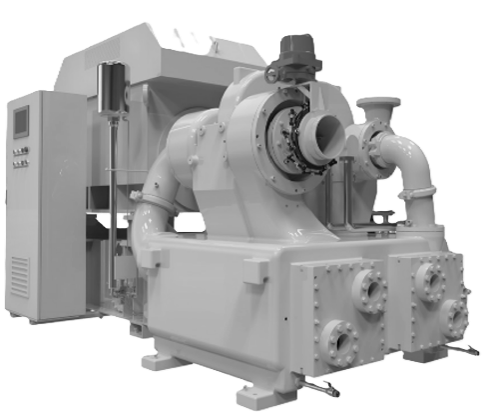
Key facts
- Discharge pressure up to 10 MPa, flow up to 160,000 m³/h.
- Driver power up to 30 MW, pressure ratio up to 35 in one machine.
- Gases: air, nitrogen, CO₂, ammonia, steam.
- API 617 for process gases, API 672 for general-purpose air.
- Built-in gearbox: each pinion shaft, carrying one or two stages, runs at its own optimum speed.
- Intercooling between stages reduces compression work and gas temperature.
Specifications
| Parameter | Value |
|---|---|
| Discharge pressureMPa | up to 10 |
| Volume flowm³/h | up to 160,000 |
| PowerMW | up to 30 |
| Pressure ratio | up to 35 |
| Gases handled | air, nitrogen, CO₂, ammonia, steam |
| Standards | API 617, API 672 |
| Gearbox | built-in |
Design features
- Arrangement
- a central bull gear drives several pinion shafts; overhung impellers sit on the shaft ends
- Stages
- several compression stages, one or two on each pinion shaft; each shaft runs at its own speed, which raises efficiency compared with a single-shaft machine
- Cooling
- intercoolers after each stage or pair of stages
- Control
- inlet guide vanes and/or variable diffusers; anti-surge protection
- Seals
- dry gas or labyrinth seals — depending on the gas and leakage requirements
- Driver
- electric motor or steam turbine
How an integrally geared compressor reaches a pressure ratio of up to 35
Three design features give a high pressure ratio in a single machine: the speed is chosen for each pinion shaft, the gas can be cooled after every stage, and each impeller takes in gas through an axial inlet — without the return channels that carry gas from impeller to impeller in a single-shaft machine.
- Pinion shafts. Each pinion shaft carries one or two overhung impellers, one at each end. Impellers on the same shaft turn at the same speed, so the gear ratio is chosen for the pair of stages. Large machines, such as Siemens Energy’s customised integrally geared compressors, have up to four pinion shafts and up to eight stages.
- Intercooling. Gas leaves each stage through a volute and goes to an intercooler — after every stage or every pair of stages. Compression comes closer to isothermal, and less power is needed for the same pressure ratio.
- Axial thrust. It is taken either by thrust bearings on the pinion shafts or by thrust collars (rider rings) that transfer it to the bull gear thrust bearing. Where a shaft has dry gas seals, API 617 requires a thrust bearing on that shaft (thrust collars only with the purchaser’s approval) and two axial position probes, as these seals are sensitive to axial movement.
API 617 or API 672: which standard to specify in the enquiry data sheet
The standard sets requirements for the machine, its testing and documentation, so it is fixed in the enquiry data sheet before proposals are requested. The main differences are the gas handled and how critical the service is.
| Feature | API 672 | API 617, Part 3 |
|---|---|---|
| Gas | air: plant and instrument air | process gases and process air |
| Service | general purpose: non-critical, the machine is usually spared; Basic package (the manufacturer’s standard unit) or Special Duty package (for higher availability) | special purpose: continuous operation in critical service, usually with no installed spare |
| Scope of supply | a complete package with accessories: coolers, lube oil system, instrumentation and controls, driver | the purchaser defines the scope in the standard’s data sheets |
| Current edition | 5th, 2019 (reaffirmed in 2024) | 9th, 2022 |
Both standards share the same lower limit: machines with a pressure rise of less than 0.35 bar (34 kPa) above atmospheric pressure are classed as fans or blowers, and fans are covered by API 673 — see industrial blowers.
Applications
Duties
- compressed air for production and instrumentation
- air separation: main air and nitrogen compressors
- CO₂ compression for urea production and utilisation
- ammonia and synthesis gas at chemical plants
- steam compressors for heat pumps and evaporation plants
What data are needed for selection
A technical and commercial proposal needs the gas data, the flow with the conditions it refers to, and the cooling conditions. These go into the enquiry data sheet; an online form is available on this page.
- gas and its composition: molar mass, moisture, impurities, toxicity and flammability — they determine the choice of seals;
- suction pressure and temperature, discharge pressure;
- flow: mass or volume flow with the reference conditions — normal (Nm³/h) or at suction (m³/h);
- operating points: minimum, rated and maximum flow;
- cooling water: temperature, permissible temperature rise and pressure — they set the gas temperature at the inlet of each stage;
- driver: electric motor and supply voltage, or a mechanical drive steam turbine and steam conditions;
- standard: API 617 or API 672, and for API 672 — a Basic or Special Duty package;
- site: climate, indoor or outdoor installation, hazardous area classification.
Service and spare parts for integrally geared compressors
We service single-shaft and integrally geared, single- and multi-stage compressor trains by Siemens Energy, Dresser-Rand, Mitsubishi Heavy Industries, Howden, Kobelco and Hanwha rated from 750 kW to 80 MW, as well as anti-surge protection and capacity control systems. The scope of work is described on the compressor service and repair page. Spare parts are supplied, among others, for Siemens Energy integrally geared compressor trains of the STC-GC, STC-GV, STC-GVT and STC-GT series — the part groups are listed on the Siemens Energy spare parts page.
During inspections of an integrally geared machine, the following are usually checked separately, in addition to the checks common to all centrifugal compressors:
- gear mesh: contact pattern and tooth surfaces. Under API 617, gear sets are designed to wear by pitting before a tooth breaks, so pitting is an early sign of wear;
- pinion shaft bearings, on the fastest shafts of the train: vibration is monitored by two non-contact probes at each radial bearing, and temperature by sensors in the bearing metal;
- intercoolers: fouling raises the gas temperature at the inlet of the next stage and the power consumed;
- the inlet guide vane actuator and the anti-surge valve.
Related
Documents
Sources and standards: the data come from the company’s current website; requirements are set by API 617 (centrifugal and axial compressors) and API 672 (integrally geared air compressors).
Questions and answers
How does an integrally geared compressor differ from a single-shaft one?
In a single-shaft machine all impellers sit on one rotor and turn at the same speed. In an integrally geared machine the built-in gearbox distributes the drive to several pinion shafts, each carrying one or two impellers, and each shaft runs at its own optimum speed — higher <a class="term-link" href="../glossary/efficiency/index.html" title="What is the efficiency of a power unit">efficiency</a> and simpler intercooling.
When does API 672 apply, and when API 617?
<a class="term-link" href="../glossary/api-standards/index.html" title="What are the API 617, 618, 619, 672, 673, 611 and 612 standards">API 672</a> covers general-purpose integrally geared air compressors. API 617 covers process gas compressors (nitrogen, CO₂, ammonia, steam) in oil, gas and chemicals, with stricter reliability requirements.
What pressure and flow are achievable?
Diaphragm compressors: up to 45 MPa at flows up to 1,000 Nm³/h; driver power up to 200 kW. Integrally geared compressors: up to 10 MPa and up to 160,000 m³/h at up to 30 MW; the pressure ratio in one machine is up to 35.
How are these compressors serviced?
<a class="term-link" href="../glossary/gas-turbine-inspection/index.html" title="What is a gas turbine inspection">Inspections</a>, seal and bearing replacement, anti-surge tuning — see compressor service and dry gas seals.
How is the capacity of an integrally geared compressor controlled?
At constant speed — by variable inlet guide vanes, variable diffuser vanes or an inlet throttle device. Air compressors to API 672 can also run in load–unload mode. When the flow falls to the anti-surge control line, the anti-surge valve opens: process gas is recycled to suction, and air is blown off to atmosphere. Under API 617, the minimum capacity without a bypass is at this line or 10% above the predicted surge flow.
What should a spare parts request for an integrally geared compressor include?
The model and serial number of the unit, the catalogue number or name of the part and the quantity; a photo of the nameplate and the parts list help. For an integrally geared machine, state which assembly the part belongs to: the bull gear, a specific pinion shaft or a stage. We confirm the origin of parts by catalogue numbers, markings and accompanying documents; every batch is inspected by our engineers before shipment.
Expert in charge
Rotating equipment serviceManufacturers’ names and designations are used to identify the equipment we supply and service. Trademarks belong to their respective owners. Energy Management LLC is an independent engineering company.