
Mechanical drive steam turbines 8 kW – 50 MW
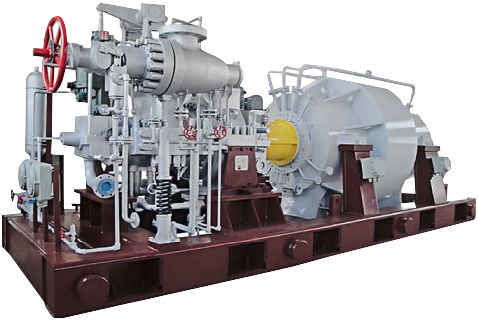
Small and medium-power steam turbines driving boiler feed and cooling water pumps, compressors, fans, induced-draught fans and crushers: 8 kW – 50 MW, 1,000–15,000 rpm, steam up to 540 °C and 14 MPa(a). Four designs — condensing and back-pressure, with or without steam extraction; packaged on a single baseplate to API 611/612.
Key facts
- Output range 8 kW – 50 MW, speed 1,000–15,000 rpm.
- Inlet steam up to 540 °C and 14 MPa(a); controlled steam extraction available.
- Four designs: condensing and back-pressure, each with or without extraction.
- Compliance with API 611 and API 612; packaged on a single baseplate — no inspection of the steam path during installation.
- Quick-closing trip valve separate from the governor valve; mechanical or electronic speed governor, e.g. Woodward, NEMA Class A.
- Turbines of this range operate at more than 150 plants in 40 countries.
Four designs
| Design | Inlet steam, MPa(a) | Inlet temperature, °C | Extraction, MPa(a) | Exhaust, MPa(a) | Speed, rpm |
|---|---|---|---|---|---|
| Condensing | 0.12–10.5 | 105–540 | — | 0.007–0.025 | 1,000–14,200 |
| Condensing with extraction | 1.0–10.5 | 180–540 | 0.2–5.0 | 0.007–0.02 | 1,000–14,200 |
| Back-pressure | 0.5–14 | 152–540 | — | 0.12–6.5 | 1,000–15,000 |
| Back-pressure with extraction | 1.0–14 | 180–540 | 0.5–6.5 | 0.12–6.5 | 1,000–15,000 |
Which design to choose
The design depends above all on the plant’s steam balance: where the steam goes after the turbine and whether intermediate-pressure steam is needed. The output and speed are set by the driven machine.
| Design | When it is chosen | What to consider |
|---|---|---|
| Condensing | there are no consumers for the exhaust steam | a condenser and a cooling system are required |
| Condensing with extraction | the demand for intermediate-pressure steam varies, while the drive must run at any extraction flow | controlled extraction holds the header pressure, and the steam in excess of the extraction flows on to the condenser; the condenser is sized for the maximum steam flow, i.e. full output at minimum extraction |
| Back-pressure | consumers constantly take all the exhaust steam: process, heating, the deaerator | the steam flow follows the load of the driven machine, so the header pressure is held by other steam sources or a pressure-reducing and desuperheating station |
| Back-pressure with extraction | consumers need steam at two pressures | extraction and exhaust flows are matched across the whole drive load range |
Why a back-pressure turbine uses fuel more efficiently is explained in the glossary entry on the back-pressure turbine.
Design features
- Valves
- the quick-closing trip valve is separate from the governor valve; a steam strainer is built into the trip valve
- Governing
- mechanical or electronic speed governor, e.g. Woodward, NEMA Class A; control system and instruments to the customer’s choice
- Bearings and seals
- tilting-pad bearings; carbon or labyrinth end seals
- Packaging
- turbine, gearbox and auxiliaries on a single baseplate — the package is ready for installation without inspection of the steam path
- Thermal insulation
- to API requirements — on request
- Automation
- a control system on a Russian control platform — on request
Speed governing and overspeed protection
The governor holds the set speed by changing the steam flow through the governor valve. Under API 611 and API 612, overspeed protection is independent of the governor: at trip speed it shuts off the steam with the trip valve. Governor accuracy is defined by Classes A–D, designated as in NEMA SM 23.
| Class | Speed regulation, max | Speed variation, max | Speed rise on load rejection, max |
|---|---|---|---|
| A | 10 | 0.75 | 13 |
| B | 6 | 0.5 | 7 |
| C | 4 | 0.25 | 7 |
| D | 0.5 | 0.25 | 7 |
- Class A is the baseline: API 611 calls for an oil-relay governor of this class. If an electronic governor is specified, it must meet Class D, whose speed regulation is 20 times tighter.
- Trip speed under API 612 is 110% of maximum continuous speed (116% of rated speed).
The company’s service specialists maintain the control, vibration monitoring and speed control systems of steam turbines — see steam turbine service and repair. In 2024, while preparing the automatic control system of a 2.4 MW single-stage Howden steam turbine for commissioning, company specialists tested a digital model of the turbine on a simulator.
Applications
What they drive
- boiler feed pumps
- cooling water pumps
- compressors
- fans and induced-draught fans
- crushers
Turbine drives for pumps, compressors and induced-draught fans
The speed of a drive turbine can be varied, so the output of a pump, compressor or fan is controlled by speed rather than by throttling.
| Machine | Features |
|---|---|
| Boiler feed pumps | a turbine-driven pump often serves as the standby for a motor-driven one, as its drive does not depend on the power grid. Under API 611, a single-stage turbine must be suitable for immediate start-up to full load, provided the inlet piping, casing and glands are warmed up and drained |
| Centrifugal compressors | the operating speeds of the turbine and a centrifugal compressor are close, so they are often coupled directly, without a gearbox; the governor is coordinated with anti-surge control; unspared units call for an API 612 design |
| Fans and induced-draught fans | the machine runs slower than suits the turbine, so a gearbox is needed; the high inertia of an induced-draught fan rotor lengthens run-up |
Related
Documents
Sources and standards: design data come from the company’s current website; requirements for general-purpose and special-purpose drive turbines are set by API 611 and API 612.
Questions and answers
How does a back-pressure turbine differ from a condensing one?
In a back-pressure turbine the exhaust steam goes to a consumer at 0.12–6.5 MPa(a) — for process or heating. In a condensing turbine the steam expands to 0.007–0.025 MPa(a) and is condensed: all the available energy goes into the drive.
When is steam extraction needed?
When the plant needs both the drive and intermediate-pressure steam at the same time: condensing turbines extract at 0.2–5.0 MPa(a), back-pressure turbines at 0.5–6.5 MPa(a).
Can a Russian control system be supplied?
Yes: the <a class="term-link" href="../glossary/automatic-control-system/index.html" title="What is the automatic control system of a turbine or compressor">turbine control system</a> can be built on a Russian control platform — see the turbine and compressor control page.
When is an API 612 turbine needed, and when is API 611 enough?
API 611 covers general-purpose turbines for spared machines or non-critical service, typically with steam up to 48 bar(g) and 400 °C and speeds up to 6,000 rpm. If the turbine drives an unspared machine in a continuous critical process, such as a main process compressor, specify API 612: it is not limited by steam conditions, power or speed.
Does the company provide installation supervision and commissioning supervision for a drive turbine?
Yes. Installation supervision and commissioning supervision can be ordered together with the supply of a new turbine: the company’s specialists support the full cycle of installation and commissioning. The service specialists are trained at the manufacturers’ works and service steam turbines made by Siemens Energy, Dresser-Rand, Mitsubishi Heavy Industries and Howden. The customer’s personnel can be trained in turbine operation and periodic maintenance.
Expert in charge
Rotating equipment serviceManufacturers’ names and designations are used to identify the equipment we supply and service. Trademarks belong to their respective owners. Energy Management LLC is an independent engineering company.