
Reciprocating compressors API 618
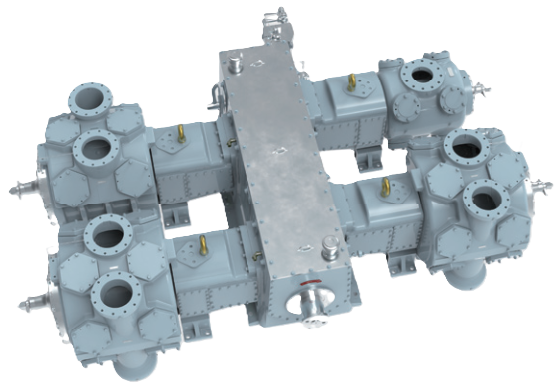
Reciprocating compressors to API 618 for process gases: discharge pressure up to 50 MPa, flow up to 115,000 m³/h, driver power up to 10 MW, from 2 to 10 cylinders. They compress natural gas, CO₂, hydrogen, air and nitrogen and are used where high pressure is needed at moderate flow.
Key facts
- Discharge pressure up to 50 MPa — higher than the centrifugal and screw machines on this site.
- Flow up to 115,000 m³/h, driver power up to 10 MW.
- From 2 to 10 cylinders; compression stages with intercooling.
- Gases: natural gas, CO₂, hydrogen, air, nitrogen.
- API 618 — reciprocating compressors for petroleum, chemical and gas industry services.
- Supplied as a package: compressor, driver, skid, coolers, separators, control system.
Specifications
| Parameter | Value |
|---|---|
| Discharge pressureMPa | up to 50 |
| Volume flowm³/h | up to 115,000 |
| PowerMW | up to 10 |
| Number of cylinders | from 2 to 10 |
| Gases handled | natural gas, CO₂, hydrogen, air, nitrogen |
| Standard | API 618 |
Design features
- Arrangement
- horizontal balanced-opposed or vertical cylinders on a common frame with a crankshaft
- Stages
- one to several compression stages; coolers and separators between the stages
- Cylinders
- from 2 to 10; lubricated or non-lubricated cylinders — depending on gas purity requirements
- Seals
- piston rod packing with leakage collection
- Capacity control
- stepped — valve unloaders and bypass; continuous — variable-speed drive
- Driver
- electric motor; gas engine for selected duties
Reciprocating or centrifugal compressor: which to choose
The choice depends on discharge pressure, flow and the molecular weight of the gas. A reciprocating compressor wins at high pressure and moderate flow, especially on light gases such as hydrogen; a centrifugal compressor wins at large flows and moderate pressure.
| Parameter | Reciprocating | Centrifugal |
|---|---|---|
| Discharge pressure of the machines on this site | up to 50 MPa | up to 15 MPa |
| Flow of the machines on this site | up to 115,000 m³/h | up to 300,000 Nm³/h |
| Light gases, hydrogen | the pressure ratio hardly depends on the molecular weight of the gas | the lighter the gas, the lower the pressure ratio per stage: hydrogen needs many stages |
| Capacity control | valve unloaders, clearance pockets, bypass, variable-speed drive | speed, inlet guide vanes; operation is limited by the surge line |
| Gas flow | pulsating: pulsation dampers are needed | continuous: anti-surge protection is needed |
More on the centrifugal compressors API 617 and hydrogen compressors pages.
How many stages and cylinders are needed
The number of stages is set by the overall pressure ratio and the allowable discharge temperature: a single stage usually raises the pressure no more than three to four times. API 618 (6th edition, May 2024) limits the predicted discharge temperature to 135 °C, and to 120 °C for hydrogen-rich gases with a molecular weight of 12 or less and for non-lubricated cylinders. A hydrogen compressor therefore usually needs more stages than a gas reciprocating compressor that compresses natural gas to the same pressure.
There may be more cylinders than stages: at high flow the first stage is split between parallel cylinders. In a balanced-opposed arrangement the cylinders are placed in pairs on either side of the crankshaft to balance the inertia forces.
Pressure pulsation and how it is controlled
The piston delivers gas in portions, so pressure pulsations arise in the suction and discharge piping. Left uncontrolled, they cause piping vibration and fatigue cracks, accelerate valve wear and distort flow meter readings. They are controlled with pulsation dampers (volume bottles on the suction and discharge of the stages) and orifice plates, while piping vibration is reduced by supports that detune the piping from mechanical resonance.
The 6th edition of API 618 drops empirical sizing of pulsation dampers: the system is designed by acoustic simulation, with mechanical analysis added at higher pressures and power per cylinder. The methods are described in API 688 (2nd edition, October 2023).
Applications
Duties
- natural gas compression for storage and fuelling
- hydrogen and synthesis gas compression at chemical plants and refineries
- high-pressure CO₂ supply
- high-pressure air and nitrogen for process needs
Wear parts and service
Valves need the most attention; piston rings, rider bands and piston rod packing are also wear parts. Their wear becomes visible before failure:
- a leaking valve — by a rise in its cover temperature;
- rider band wear — by rod drop;
- packing wear — by increased leakage into the vent line.
Requirements for protection systems monitoring piston rod position and crosshead vibration are set by API 670 (6th edition, 2025).
Reciprocating compressor trains are maintained by our rotating equipment service team; the scope of work is given on the compressor service and repair page. We supply spare parts for, among others, Dresser-Rand ESH, PHE, HSE, HHE, BDC, MOS, HOS and HOSS reciprocating compressors — see the list of models.
Related
Documents
Sources and standards: the data come from the company’s current website; requirements are set by API 618 (reciprocating compressors for petroleum, chemical and gas industry services).
Questions and answers
When is a reciprocating compressor chosen over a centrifugal one?
When a high discharge pressure — up to 50 MPa — is needed at a relatively small flow, and when the gas composition varies: the capacity of a reciprocating machine depends less on gas density.
How many cylinders does the compressor have?
From 2 to 10 — the number and size of the cylinders are selected for the flow, pressure and number of stages.
Which gases can be compressed?
Natural gas, CO₂, hydrogen, air, nitrogen. For pure and aggressive gases at small flows <a class="term-link" href="../glossary/diaphragm-compressor/index.html" title="What is a diaphragm compressor">diaphragm compressors</a> are also considered.
How are reciprocating compressors serviced?
Replacement of valves, piston rings and rod packing by running hours, vibration and temperature monitoring — see compressor service and <a class="term-link" href="../glossary/spare-parts/index.html" title="What spare parts are and how their origin is confirmed">spare parts</a>.
What data are needed to select a reciprocating compressor?
The gas composition including impurities and moisture, suction pressure and temperature, discharge pressure, normal, minimum and maximum flow, capacity control modes, driver type, site climate and hazardous area classification, and whether oil carry-over into the gas is acceptable. From these data we size and select the compressor for the duty; the easiest way to send them is the online enquiry data sheet.
Are all reciprocating compressors built to API 618?
No. API 618 covers low- to moderate-speed reciprocating compressors for the petroleum, chemical and gas industries, with lubricated or non-lubricated cylinders. High-speed separable balanced-opposed packages for oil and gas production are built to API 11P, and the 6th edition of API 618 explicitly excludes diaphragm compressors. The required standard is stated in the enquiry data sheet, as it determines the design and testing requirements.
Expert in charge
Rotating equipment serviceManufacturers’ names and designations are used to identify the equipment we supply and service. Trademarks belong to their respective owners. Energy Management LLC is an independent engineering company.