
Blowers and fans API 673
Centrifugal machines that move air and process gases with a modest rise in pressure: pressure ratio up to 1.7, flow up to 300,000 Nm³/h, driver power up to 5 MW. Vertically and horizontally split casings; built to API 673.
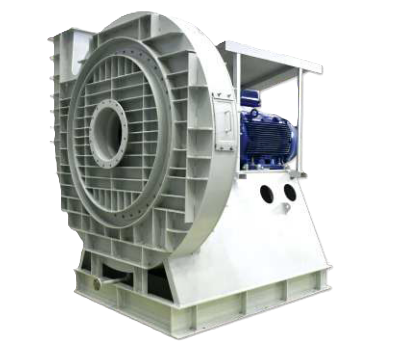
Key facts
- Pressure ratio up to 1.7 — the fan and blower range; in the textbook classification, compressors are machines above 3.0 with gas cooling.
- Flow up to 300,000 Nm³/h, driver power up to 5 MW.
- Type: centrifugal blowers and fans (turbo blowers).
- Gases: air and process gases.
- Vertically or horizontally split casing — depending on maintenance access.
- API 673 — centrifugal fans for petroleum, chemical and gas industry services.
Specifications
| Parameter | Value |
|---|---|
| Pressure ratio | up to 1.7 |
| Volume flowNm³/h | up to 300,000 |
| PowerMW | up to 5 |
| Types | centrifugal blowers and fans |
| Gases handled | air, process gases |
| Casing split | vertical and horizontal |
| Standard | API 673 |
What API 673 requires
API 673, Centrifugal Fans for Petroleum, Chemical, and Gas Industry Services (third edition, December 2014, reaffirmed in 2025), sets minimum requirements for design, materials, inspection and testing: lateral critical speed analysis of the rotor, permissible residual unbalance, vibration limits, bearings and the lube oil system, testing before shipment and data sheets. The static pressure rise is usually no more than 330 cm (130 in.) of water, about 32 kPa, from a single impeller or from each impeller of a two-stage fan. The standard does not apply to axial flow and ventilation fans, air-cooled heat exchanger and cooling tower fans, or positive displacement blowers.
Types and how they differ from compressors
- Difference from compressors
- blowers and fans move large volumes of gas at a pressure ratio of up to 1.7 without gas cooling; compressors with a pressure ratio above 3.0 cool the casing and the gas between stages — see “Fan, blower or compressor: where the line lies”
- Centrifugal (turbo blowers)
- one or more impellers on a shaft; the gas is accelerated in the impeller and slowed in the diffuser and volute, raising its pressure; suited to a steady head at varying flow
- Axial fans
- the flow passes along the axis of rotation through the blading; maximum flow at a small pressure rise — draught fans, ventilation, cooling
- Casing
- vertically or horizontally split — by the way the rotor is accessed for repair
- Control
- inlet guide vanes, adjustable blades or a variable-speed drive
- Driver
- electric motor, direct or through a speed increaser; steam turbine
Fan, blower or compressor: where the line lies
There is no single boundary between a fan, a blower and a compressor: they are told apart by pressure ratio — the absolute discharge pressure divided by the inlet pressure. GOST 34002-2016 (ISO 13349:2010) treats a machine with a pressure ratio of no more than 1.3 as a fan. Russian-language engineering textbooks put the fan boundary lower:
| Class | Pressure ratio | Cooling |
|---|---|---|
| Fan | up to 1.15 | not needed |
| Blower (gas blower) | 1.15–3.0 | no forced cooling |
| Compressor | above 3.0 | cooling of the casing and of the gas between stages |
The blowers and fans we offer work at pressure ratios of up to 1.7. If the process needs a higher pressure, the choice is a centrifugal compressor to API 617.
Applications
Duties
- air and process gas supply to furnaces and reactors
- aeration in water treatment and biochemical processes
- pneumatic conveying of bulk materials
- induced-draught and forced-draught fans for boilers and furnaces
Industries
Aeration and process air: what drives the selection
At a wastewater treatment plant an industrial blower delivers air to the diffusers in the aeration tanks. Under the Russian code SP 32.13330.2018 (clause 9.2.7.15), the working pressure is set by the diffuser submergence and the losses in the pipework and diffusers, allowing for their resistance at the end of the design life and for seasonal and climatic factors. Air demand follows the load, so in systems with flexible or stepped air supply control the blowers must regulate their output over at least 40–100 % of the design maximum at constant pressure. Aeration can be the most energy-intensive treatment step: according to the US Environmental Protection Agency, it accounts for 25 to 60 % of a plant’s energy use.
In process plants the blower supplies air or process gas to furnaces, reactors and dryers. The composition, temperature and dust load of the gas and any corrosive or explosive components determine the materials of the flow path, the shaft seals and the design of the driver. For petrochemicals, refining and the gas industry, the requirements for centrifugal machines of this class are set out in the industry standard API 673.
Capacity control and energy efficiency
At part load, a blower’s energy use depends on how its output is controlled: the less of the pressure it builds is lost across control devices, the more economical the machine. For wastewater treatment plants, SP 32.13330.2018 requires the units to be selected by a technical and economic calculation that allows for control and for the specific energy use per 1,000 m³ of air, and recommends units with an efficiency above 80 % at plants classed as large or larger.
| Method | How it works | Energy efficiency |
|---|---|---|
| Discharge throttling | a valve downstream of the machine adds resistance | low: pressure is built and then lost across the valve |
| Inlet throttling | a damper at the inlet lowers the gas density and mass flow | better than discharge throttling |
| Inlet guide vanes | adjustable vanes pre-swirl the flow ahead of the impeller | more economical than throttling |
| Variable diffuser vanes | change the flow area after the impeller; on single-stage machines, together with inlet guide vanes | efficiency is held over a wide flow range |
| Variable-speed drive | the driver speed is changed | on multistage machines, 15–20 % more efficient than throttling |
At the low end, the control range of any centrifugal machine is limited by the surge line, so protection is needed, built on the same principles as anti-surge control for compressors. Anti-surge protection and capacity control systems are on the list of equipment maintained by our turbine and compressor service.
Related
Documents
Sources and standards: the data come from the company’s current website; requirements are set by API 673 (centrifugal fans for petroleum, chemical and gas industry services).
Questions and answers
How does a blower differ from a compressor?
By pressure ratio and cooling. There is no single boundary: under GOST 34002-2016 a fan is a machine with a pressure ratio of up to 1.3; in the textbook classification, <a class="term-link" href="../glossary/blower/index.html" title="What is a blower and how it differs from a compressor">blowers</a> (gas blowers) work at 1.15–3.0 without forced cooling, and compressors above 3.0, with the gas cooled between stages. A blower moves a large volume of gas at a small head; a compressor raises the gas to a high pressure.
What is a turbo blower?
A centrifugal <a class="term-link" href="../glossary/blower/index.html" title="What is a blower and how it differs from a compressor">blower</a>: the gas is accelerated by the impeller and slowed in the diffuser, which raises its pressure. It is used where a steady head is needed at varying flow.
What flow and power are achievable?
Up to 300,000 Nm³/h at a driver power of up to 5 MW; the gases are air and process gases.
How are blowers serviced?
<a class="term-link" href="../glossary/gas-turbine-inspection/index.html" title="What is a gas turbine inspection">Inspections</a>, vibration diagnostics and rotor balancing, bearing and seal replacement — see compressor service and vibration diagnostics.
What discharge pressure does an aeration blower need?
The discharge pressure is the hydrostatic pressure of the water above the diffusers — about 9.8 kPa per metre of depth — plus losses in the filter, pipework, valves and diffusers. Diffuser resistance rises as they foul, so SP 32.13330.2018 requires the end-of-life value to be used. Too large a margin does harm: the surplus pressure is then throttled away and energy is wasted. In your enquiry, state the diffuser depth and type.
Is an API 673 design mandatory?
No. API 673 is a voluntary industry standard: it applies when the customer calls for it, typically for fans in refining, chemical and gas plants, for which it was written. The customer also chooses the class of machine — general purpose or special purpose; special purpose machines carry additional requirements. The blowers and fans we offer meet the requirements of API 673, so a design to the standard can be specified in your enquiry.
Expert in charge
Rotating equipment serviceManufacturers’ names and designations are used to identify the equipment we supply and service. Trademarks belong to their respective owners. Energy Management LLC is an independent engineering company.