
Industrial compressors: centrifugal, reciprocating, screw, diaphragm
Centrifugal, reciprocating, screw and diaphragm compressors for a wide range of processes and gases. We size and select the machine for the duty: pressure up to 50 MPa, flow up to 300,000 Nm³/h, driver power up to 30 MW; hydrocarbons, hydrogen, CO₂, ammonia, air and nitrogen; manufactured to API 617, 618, 619, 672 and 673.
Key facts
- Six types: centrifugal, integrally geared, reciprocating, diaphragm, screw, and blowers and fans.
- Discharge pressure up to 50 MPa (reciprocating), flow up to 300,000 Nm³/h (centrifugal, blowers).
- Driver power up to 30 MW — from a steam turbine or an electric motor.
- Pressure ratio up to 25 on centrifugal machines and up to 35 on integrally geared trains.
- Service and spare parts for STC, Datum, Kobelco and Hanwha compressors — with our own engineers.
Compressor types
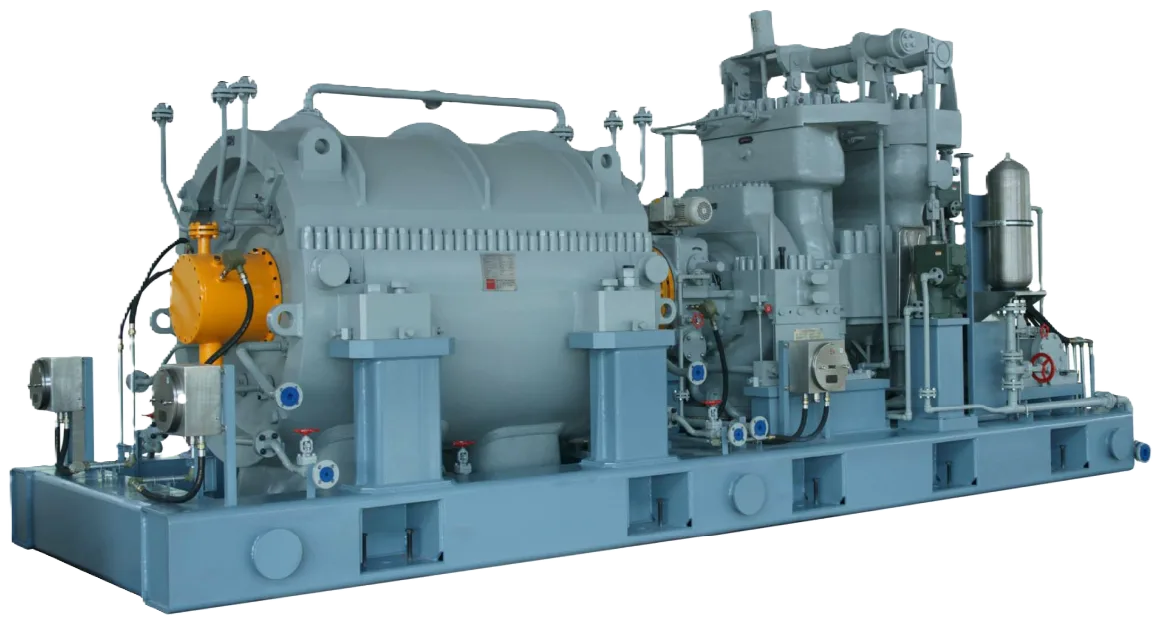
Centrifugal compressors API 617
Centrifugal compressor trains to API 617 for hydrocarbons, syngas, CO₂, ammonia, ethylene, propylene, hydrogen, air and nitrogen: discharge pressure up to 15 MPa, flow up to 300,000 Nm³/h, driver power up to 30 MW, pressure ratio up to 25. Vertically or horizontally split casing; driven by a steam turbine or an electric motor.
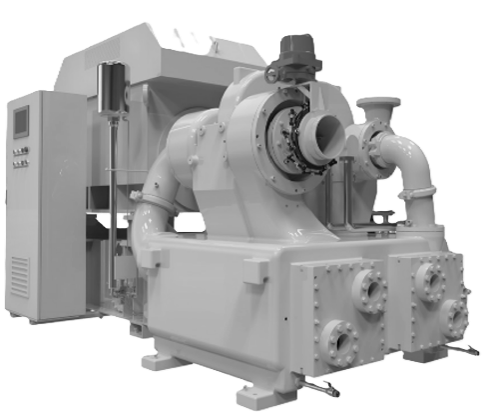
Integrally geared compressors API 617 and API 672
Centrifugal compressors with a built-in gearbox: several high-speed pinion shafts with impellers arranged around a central bull gear. Discharge pressure up to 10 MPa, flow up to 160,000 m³/h, power up to 30 MW, pressure ratio up to 35. For air, nitrogen, CO₂, ammonia and steam; to API 617 (process gases) and API 672 (air).
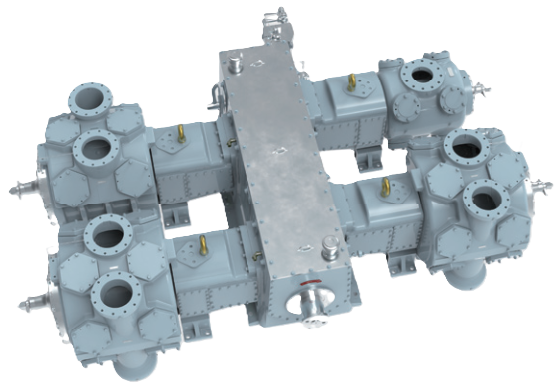
Reciprocating compressors API 618
Reciprocating compressors to API 618 for process gases: discharge pressure up to 50 MPa, flow up to 115,000 m³/h, driver power up to 10 MW, from 2 to 10 cylinders. They compress natural gas, CO₂, hydrogen, air and nitrogen and are used where high pressure is needed at moderate flow.
Diaphragm compressors up to 45 MPa
Diaphragm compressors for pure, hazardous, rare and corrosive gases: discharge pressure up to 45 MPa, flow up to 1,000 Nm³/h, power up to 200 kW, vertically and horizontally split heads. The gas is separated from the hydraulic oil by a metal diaphragm and does not come into contact with the atmosphere — compression without contamination or leakage.
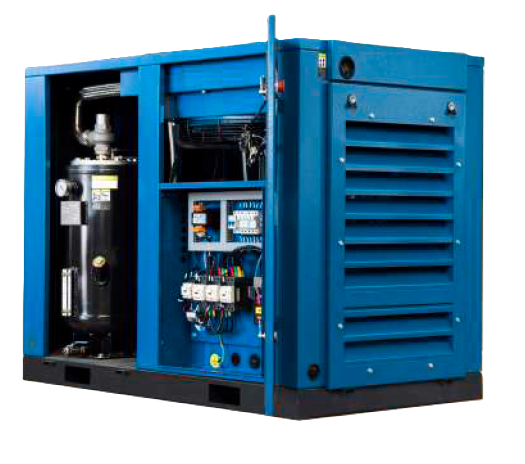
Screw compressors API 619
Screw compressors to API 619: discharge pressure up to 1.3 MPa at atmospheric suction, flow up to 1,070 m³/min, driver power up to 1.8 MW. Oil-free and oil-injected designs, packaged on a common skid. For hydrocarbons, air and process gases.
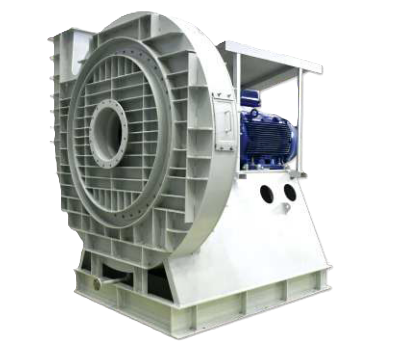
Blowers and fans API 673
Centrifugal machines that move air and process gases with a modest rise in pressure: pressure ratio up to 1.7, flow up to 300,000 Nm³/h, driver power up to 5 MW. Vertically and horizontally split casings; built to API 673.
Summary table
| Type | Discharge pressure | Flow | Power | Features | Gases | Standard |
|---|---|---|---|---|---|---|
| Centrifugal compressor trains | up to 15 MPa | up to 300,000 Nm³/h | up to 30 MW | pressure ratio up to 25; vertically and horizontally split casing; driven by a steam turbine or an electric motor | hydrocarbons, syngas, CO₂, ammonia, ethylene, propylene, hydrogen, air, nitrogen | API 617 |
| Integrally geared | up to 10 MPa | up to 160,000 m³/h | up to 30 MW | pressure ratio up to 35 | air, nitrogen, CO₂, ammonia, steam and others | API 617, API 672 |
| Reciprocating | up to 50 MPa | up to 115,000 m³/h | up to 10 MW | from 2 to 10 cylinders | natural gas, CO₂, hydrogen, air, nitrogen | API 618 |
| Diaphragm | up to 45 MPa | up to 1,000 Nm³/h | up to 200 kW | vertically and horizontally split | hydrogen, CO₂, hydrogen chloride, hazardous, rare and corrosive gases | — |
| Screw | up to 1.3 MPa (atmospheric suction) | up to 1,070 m³/min | up to 1.8 MW | oil-free and oil-flooded; modular packaging | hydrocarbons, air, industrial gases | API 619 |
| Blowers and fans | pressure ratio up to 1.7 | up to 300,000 Nm³/h | up to 5 MW | vertically and horizontally split | air, industrial gases | API 673 |
Selection by gas handled
Related
Documents
Questions and answers
To which standards are the compressors built?
Centrifugal to <a class="term-link" href="../glossary/api-standards/index.html" title="What are the API 617, 618, 619, 672, 673, 611 and 612 standards">API 617</a>, integrally geared to API 617 and API 672, reciprocating to API 618, screw to API 619, blowers and fans to API 673.
How does an integrally geared compressor differ from a centrifugal one?
In an integrally geared machine the stages sit on separate shafts around a common gearbox and each runs at its optimum speed — hence a pressure ratio up to 35 at flows up to 160,000 m³/h. A classic centrifugal train has one shaft with the stages in a single casing, up to 300,000 Nm³/h and 15 MPa.
What is needed for a selection?
Gas composition and inlet conditions, the required discharge pressure and flow, the site conditions and the type of driver. The easiest route is the enquiry <a class="term-link" href="../glossary/data-sheet/index.html" title="What is a data sheet">data sheet</a>: fill it in online.
Do you service compressors made by other manufacturers?
Yes: centrifugal and reciprocating trains by Siemens Energy, Dresser-Rand, Mitsubishi Heavy Industries, Howden, Kobelco and Hanwha rated 750 kW – 80 MW.
Expert in charge
Rotating equipment serviceManufacturers' names and designations are used to identify the equipment we supply and service. Trademarks belong to their respective owners. Energy Management LLC is an independent engineering and service company.