Migration from SPPA-T3000 and PCS7 to a Russian control platform
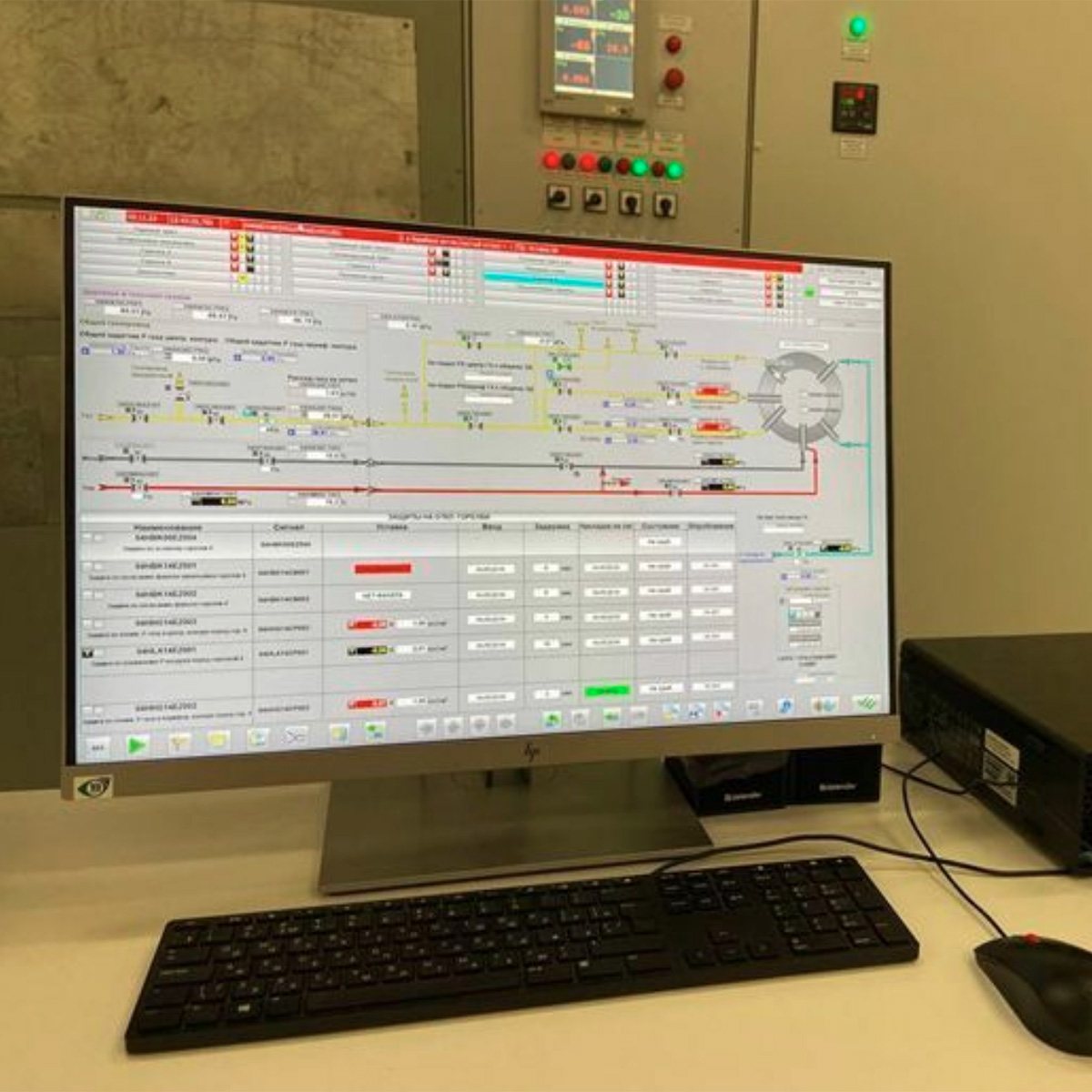
We support operating Siemens Energy SPPA-T3000 and SIMATIC PCS 7 systems and replace them in stages with the Russian Ezan control platform on Katren and Sonet controllers. The sequence is survey, development, bench testing, commissioning; protection and control algorithms are preserved, and changeovers take place during planned outages.
Key facts
- Support of operating SPPA-T3000 and SIMATIC PCS 7 systems: diagnostics, fault clearance, application software changes.
- Target platform — the Russian Ezan control platform on Katren and Sonet controllers.
- Four steps: survey, development, bench testing, commissioning.
- Protection and control algorithms are transferred with their logic unchanged; changeover is staged, during planned outages.
- Our own test bench: the new system is checked before going to site, including on an equipment model.
- Example of PCS 7 work — Knauf Petroboard: application software, cabinets, factory acceptance tests.
Why migrate from SPPA-T3000 and PCS 7 to a Russian control platform
An operating control system does not stop working because its manufacturer has left, but it becomes harder to maintain every year, and for significant critical information infrastructure (CII) objects the transition is required by law.
Support and spare parts
- In 2022, Siemens put deliveries to Russia on hold and announced the wind-down of its industrial business in the country, and Siemens Energy stopped taking on new business there. Updates, licences and support for SPPA-T3000 and SIMATIC PCS 7 are not available in Russia through the manufacturer’s official channels.
- The manufacturer does not supply spare SIMATIC S7-400 controllers, I/O modules or servers to Russia, so the origin and compatibility of each replacement have to be checked separately.
- Each version of SPPA-T3000 and PCS 7 is released for specific Windows versions and computer models, so replacing a failed operator station or server depends on compatibility and licences.
Requirements for significant CII objects
- Since 1 January 2025, government bodies and customers purchasing under Federal Law 223-FZ (other than organisations with municipal participation) have been prohibited from using foreign software at significant CII objects they own, unless otherwise provided by federal law (subclause (b), clause 1 of Presidential Decree No. 166 of 30 March 2022).
- Since 1 September 2025, CII subjects have been required to use, at significant objects, software listed in the Unified Register of Russian Software or software used in state information systems; the procedure and deadlines for the transition are set by the Russian Government (clause 5, Part 3, Article 9 and clause 7, Part 2, Article 6 of Federal Law No. 187-FZ of 26 July 2017 as amended by Federal Law No. 58-FZ of 7 April 2025).
- By 1 January 2030, CII subjects are to switch to predominantly trusted hardware and software systems at significant objects, and non-trusted systems purchased since 1 September 2024 may not be used there if trusted Russian-made equivalents exist (Russian Government Resolution No. 1912 of 14 November 2023).
Whether a system is a significant object is established by CII categorisation, so migration and categorisation are best planned together.
Migration sequence
- 1
Survey
system composition, I/O, algorithms, documentation
- 2
Development
design, application software and cabinets on the Ezan platform
- 3
Bench testing
checking algorithms and interfaces on the bench and the model
- 4
Commissioning
staged changeover during planned outages, trial operation
Staged or all at once: choosing the migration approach
The approach is chosen after the survey: it determines the number of outages, the temporary interfaces between systems and the load on personnel. In both approaches, the field level — sensors, actuators and cables — is kept wherever possible: new cabinets are connected to the existing terminal blocks or through adapter cables.
| Criterion | Staged, subsystem by subsystem | All at once, in a single outage |
|---|---|---|
| Replaced per outage | controllers, cabinets and screens of one or more subsystems | the whole system: controllers, cabinets, servers and operator stations |
| When it suits | the plant cannot be shut down for long, and the schedule has several planned outages | a long major overhaul or reconstruction, or a small system |
| Temporary interfaces | during the transition, the old and new parts exchange signals through a gateway, which is tested on the bench | not needed |
| Personnel | for a while, operators work with two interfaces | switch to the new interface at once; training takes place before the outage |
| Main risk | errors at the boundary between the old and new parts | the entire scope of work has to fit into one outage |
What data the survey needs
The more complete the initial data, the more accurately the survey shows the scope of the transfer. If there are no backups or they are out of date, the logic is reconstructed from the running system and its documentation, which makes the survey larger.
- backups of the SPPA-T3000 project or the PCS 7 multiproject (for PCS 7: hardware configuration, CFC and SFC charts, operator station projects);
- I/O signal lists with ranges, protection and alarm setpoints;
- cabinet drawings, cable schedules and field device connection diagrams;
- the network diagram and a list of interfaces to adjacent systems: unit control systems, relay protection and plant-level systems;
- operating documentation and a log of failures and application software changes;
- the planned outage schedule and operating mode constraints.
What we transfer
- Algorithms
- protections, interlocks, controllers and sequences — with logic and setpoints preserved
- I/O
- field signals and interfaces to adjacent systems; cable routes and terminal blocks are kept where possible
- Visualisation
- mimic diagrams, trends and event archives are reproduced on the operator stations of the new platform
- Cybersecurity
- network segmentation and platform protection under Law 187-FZ — together with the migration
- Redundancy
- the server level — on a HyperSphere (ГиперСфера) fault-tolerant cluster where required
- Documentation and training
- operating documentation and training of the customer’s personnel
Test bench: SPPA-T3000 versions and testing of security updates
The company’s test bench has controller, server and communication equipment and all versions of the SPPA-T3000 software available in Russia. Before going to site, this makes it possible to reproduce a configuration close to the one installed at the customer’s plant and to check application software changes on it.
The bench also serves cybersecurity. An antivirus update on a server or operator station can disrupt the control system, so control system manufacturers issue lists of tested security products: Siemens publishes such lists for PCS 7, and Siemens itself tested the compatibility of Kaspersky Industrial CyberSecurity for Nodes with SPPA-T3000. On the company’s bench, antivirus signature updates and Kaspersky Industrial CyberSecurity (KICS) software updates are tested for compatibility with PCS 7 and SPPA-T3000 based systems before they are installed on control systems in service. More on the cybersecurity for industrial control systems page.
Modelling and simulator testing before work on site is becoming a mandatory stage of the company’s projects where neither the original software nor direct support from the equipment manufacturer is available (see digital twins and simulators for power equipment). For example, testing of the digital model of a 2.4 MW Howden steam turbine has been completed to prepare the control system for commissioning.
How to reduce downtime at changeover
Downtime is determined by the work that cannot be done without an outage, so everything possible is checked in advance.
- Testing before the outage. Factory acceptance tests follow a programme agreed with the customer: the logic, screens, messages and interfaces of the new system are checked before shipment, so tested cabinets arrive on site.
- Changeover programme. For each outage, a list of signals to be switched over, the sequence for connecting and checking channels and the criteria for a subsystem’s readiness for start-up are drawn up in advance.
- Preparation without an outage. Cabinet locations, cables and adapter connections are prepared while the plant is running, where safety requirements allow.
- Fallback plan. As a rule, the old equipment is not dismantled until integrated testing has been passed: if the test fails, the subsystem returns to the previous system.
- Personnel training. Operators learn the screens of the new system before the changeover, on the bench or a simulator (see training of the customer’s personnel).
The timing of each stage is agreed with the customer after the survey and aligned with the planned outage schedule.
Track record
Knauf Petroboard: steam boiler control system
application software on SIMATIC PCS 7, control cabinets, factory acceptance tests
SolutionTurbine and compressor controls on the Ezan platform
new control systems and replacement of existing ones on a Russian platform
Test benchEquipment models for bench testing
debugging the transferred algorithms before going to site
Experience with SIMATIC PCS 7: the Knauf Petroboard CHP boiler
This is a new system rather than a migration, but it runs on the same platform from which algorithms are transferred. For the Knauf Petroboard CHP plant in Kommunar, the company’s specialists developed the SIMATIC PCS 7 application software for the control system of the E-100-3.9-440 GM steam boiler made by Belenergomash-BZEM LLC, supplied and assembled the control cabinets, carried out the factory acceptance tests and performed commissioning work at the CHP plant.
In its letter of appreciation of 5 February 2024, the boiler manufacturer wrote: “Despite the difficulties caused by the enforced reorganisation of Siemens Energy in Russia, the engineering and commissioning work on the process control system was carried out to a consistently high standard of quality.” More on the project page.
Related
Questions and answers
Does production have to stop during the migration?
Replacement is staged and units are switched over during planned outages; the operating system is supported until the transition is complete.
Will the protection algorithms be preserved?
Yes: the logic of protections, interlocks and controllers is transferred to the Ezan platform unchanged and checked on the bench before <a class="term-link" href="../glossary/commissioning/index.html" title="What is commissioning">commissioning</a>.
How long does a migration take?
It depends on the system composition and the plant outage schedule; the sequence and stages are agreed after the survey.
Can SPPA-T3000 or PCS 7 stay for now?
Yes, we support operating systems: diagnostics, fault clearance, application software changes — and plan the replacement for a time that suits the plant.
Is migration mandatory for CII objects?
For significant CII objects, yes. Since 1 January 2025, government bodies and customers purchasing under Federal Law 223-FZ have been prohibited from using foreign software at such objects (Presidential Decree No. 166). Since 1 September 2025, Federal Law 187-FZ has required CII subjects to use software from the Register of Russian Software, or software used in state information systems, at significant objects; the procedure and deadlines are set by the Russian Government.
How can antivirus protection of SPPA-T3000 and PCS 7 be updated without manufacturer support?
Updates should not be installed on a control system in service without testing: they can disrupt servers and operator stations. On the company’s test bench, antivirus signature updates and Kaspersky Industrial CyberSecurity software updates are tested for compatibility with PCS 7 and SPPA-T3000 based systems, and only then are they installed on site.
Expert in charge
Process control systemsManufacturers’ names and designations are used to identify the equipment we supply and service. Trademarks belong to their respective owners. Energy Management LLC is an independent engineering company.