
Cybersecurity for industrial control systems
Protection of control systems at power facilities and industrial plants: security assessment of information systems, network security, support for modernisation of control system platforms. Security tools are tested on our own control system test bench. The work is performed under an FSTEC of Russia licence for technical protection of confidential information.
Key facts
- Security assessment of information and control systems: inventory, vulnerabilities, threat model.
- Network security: segmentation of the process network, firewalls, remote access control.
- Support for modernisation of control system platforms with information protection requirements in mind.
- Our own test bench for security tools for control system platforms — before deployment on site.
- FSTEC of Russia Licence No. Л024-00107-77/01590240 of 4 December 2024 for technical protection of confidential information.
- Partner of the Kaspersky hackathon on cyber-immune development (April 2023).
Threats to control system security and protective measures
Threats to control systems usually arrive not through the controllers themselves but through the computers and channels around them: contractors’ remote access, removable media, software updates, links with the corporate network and internet access from operator and engineering stations. According to Kaspersky ICS CERT, in Q2 2026 malicious objects were blocked on 19.2% of ICS computers protected by Kaspersky products; the internet, email clients and removable media remain the main sources of threats.
| Threat channel | How it shows up | Protective measures |
|---|---|---|
| Remote access | contractors’ permanent VPN connections, shared accounts | access only for the duration of the work via a dedicated gateway, authentication and access management, logging of actions |
| Removable media | USB drives and commissioning engineers’ laptops at operator and engineering stations | a register of media, checks on a separate station, autorun and unregistered devices blocked |
| Updates | an operating system or antivirus database update that is incompatible with the control system software | bench testing, staged installation starting with one side of a redundant pair |
| Link with the corporate network | direct access from the office network to servers and controllers | segmentation into zones, firewalls, an intermediate zone for data exchange |
| Vulnerable components | industrial protocols without authentication, station operating systems that cannot be updated | segment isolation, integrity control, network traffic monitoring |
| Staff actions | excessive privileges, shared passwords, errors when changing the configuration | role-based access, event logging, staff training |
For a specific system, threats are assessed using the FSTEC of Russia Methodology for Assessing Information Security Threats (approved on 5 February 2021) and the FSTEC threat database. Measures are chosen so as not to interfere with control. For significant CII objects, this is an express requirement of clause 21 of the Requirements approved by FSTEC of Russia Order No. 239: security measures must be consistent with industrial and functional safety measures and must not adversely affect the operation of the facility in its design modes.
What we do
- Security assessment
- survey of the control system and adjacent systems, vulnerability search, risk assessment and remediation recommendations
- Network security
- segmentation of the control system network, firewalls, secure remote access for service engineers
- Platform protection
- selection and configuration of security tools for controllers, servers and operator stations without disrupting the control system
- Modernisation
- support for platform replacement and upgrades while keeping information protection requirements — together with the control system project
- Security control
- periodic checks of the settings and state of the security tools
- Legal requirements
- measures under Law 187-FZ for critical information infrastructure — see the categorisation page
Control system security assessment: stages and results
A security assessment shows how the control system could be attacked and which gaps to close first. The customer receives a description of possible attack vectors, an information security risk assessment and recommendations on preventive measures, from security tool settings to changes in the network architecture.
- Scope and inventory. A list of controllers, servers, operator and engineering stations, network equipment and software versions; the network diagram and the connection points of external systems.
- Documentation and settings. User accounts and privileges, firewall rules, remote connections, procedures for removable media and updates.
- Known vulnerabilities. The installed software and updates are checked against the FSTEC of Russia threat database. Active scanning can disrupt controllers and stations, so it is carried out on a mock-up or during planned outages. Clause 12.6 of the Order No. 239 Requirements also allows vulnerability analysis on a mock-up (in a test zone).
- Threat model and risk assessment. For each threat, the consequences for the process and the likelihood of it being realised are assessed. Under IEC 62443-3-2, the system is divided into zones and the conduits between them, and a target security level is set for each zone and conduit.
- Recommendations. Measures and the order in which to implement them. Where a measure cannot be applied without harming system operation, compensating measures are proposed; for significant CII objects, this is expressly required by clause 26 of the Order No. 239 Requirements.
Network architecture audits, selection of security tools and information security risk assessments are carried out by our IT and cybersecurity team; control of the protection of confidential information against unauthorised access is performed under our FSTEC of Russia licence for technical protection of confidential information.
Security tool test bench
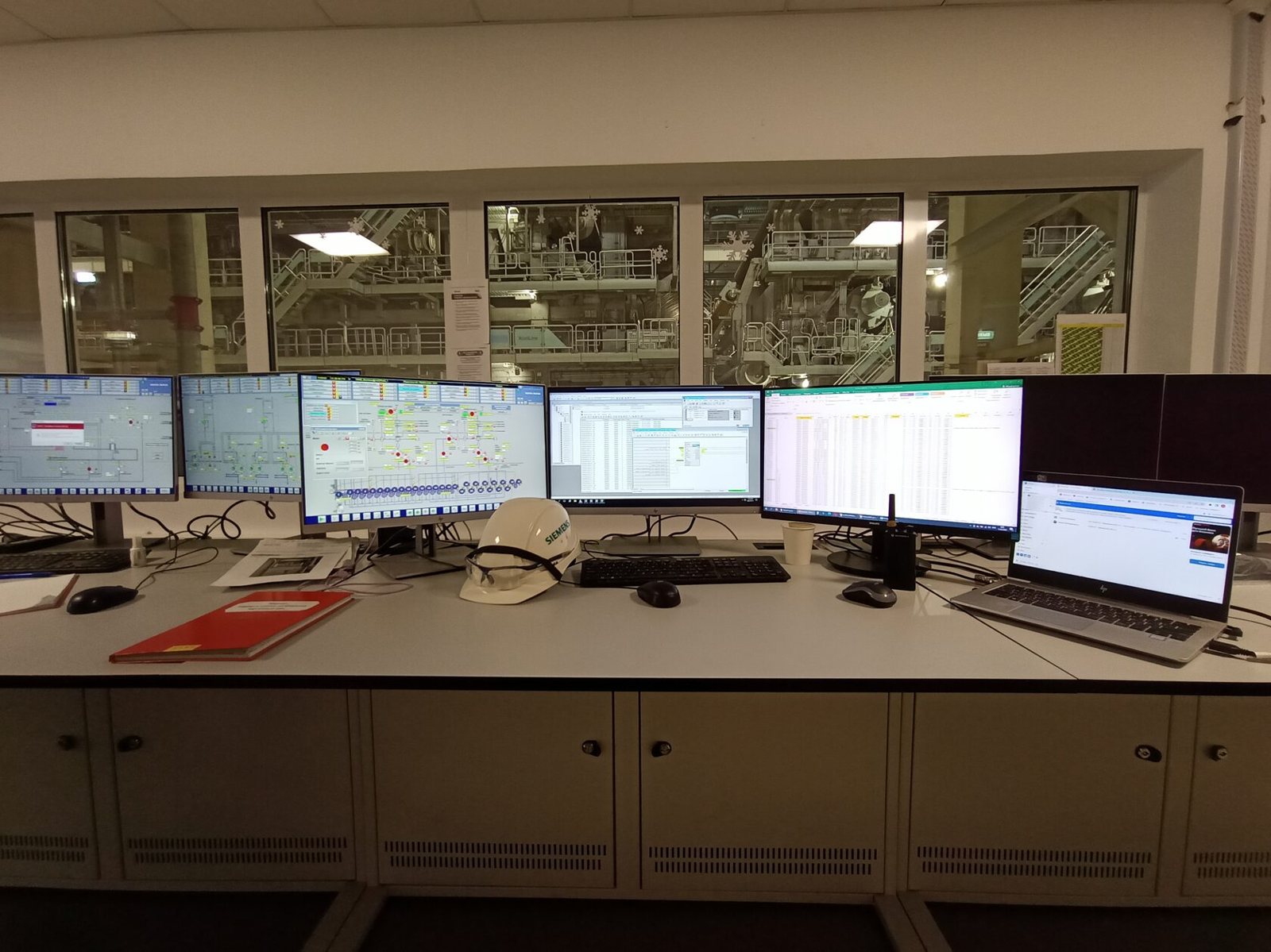
Our own test bench reproduces the control system platform: controllers, servers, operator stations and the network. Security tools are checked for compatibility with the control system before installation on site.
- 1
Reproducing the platform
a configuration close to the customer’s site
- 2
Installing updates
antivirus signature databases and Kaspersky Industrial CyberSecurity (KICS) software updates
- 3
Verification
impact on control system performance and stability
- 4
Report and deployment
recommendations and settings for the site
Bench testing of KICS updates for PCS 7 and SPPA-T3000
On our bench, updates to antivirus signature databases and to Kaspersky Industrial CyberSecurity (KICS) software are tested for compatibility with systems based on SIMATIC PCS 7 and SPPA-T3000 before they are installed on site. The bench has controller, server and communication equipment and all versions of SPPA-T3000 software available in Russia.
Why antivirus updates need testing. In a control system, the antivirus itself can cause a failure: a new signature may wrongly identify control system software files as malicious, and an antivirus engine update may require a station reboot. Siemens’ manual on managing virus scanners in PCS 7 therefore recommends the following:
- load new signatures first onto a small test system that reproduces the main functions of the live system;
- if no faults occur, install them on one group: one server from each redundant pair and half of the clients;
- after an observation period, install them on the remaining groups;
- configure the antivirus to raise a message when it detects a threat, without automatically deleting, blocking or moving files.
The main KICS products are KICS for Nodes, which protects control system servers and workstations, including SCADA servers, and KICS for Networks, which detects threats and anomalies in industrial network traffic. Bench testing is in line with the FSTEC of Russia approach: when protection for a significant CII object is designed, a mock-up or test environment may be used to confirm the compatibility of security tools and to rule out any effect on the facility (clause 11.2 of the Order No. 239 Requirements). Bench tests are also part of control system migration from SPPA-T3000 and PCS 7 to a Russian control platform.
Technical protection of confidential information
Licence No. Л024-00107-77/01590240 of for technical protection of confidential information:
- design, in protected configuration, of information systems and facilities, of rooms housing information systems subject to protection and of protected rooms
- control of the protection of confidential information against unauthorised access and modification in information systems and facilities
- installation, assembly, adjustment, testing and repair of software (software and hardware) information security tools, secure software (software and hardware) information processing tools and software (software and hardware) tools for monitoring the effectiveness of information protection
Which FSTEC requirements apply to control system security
The set of mandatory measures depends on the status of the system. If a control system is a significant CII object, FSTEC of Russia Order No. 239 of 25 December 2017 (as amended on 28 August 2024) and Order No. 235 of 21 December 2017 apply. The baseline set of measures is determined by the significance category (1, 2 or 3) and is then adapted to the threats in the threat model and supplemented. If a control system at a critical or potentially hazardous facility is not a significant CII object, Order No. 31 of 14 March 2014 (as amended on 15 March 2021) applies where the system owner has decided to protect the information it processes; the measures depend on the security class K1, K2 or K3.
The content of the measures under Orders No. 239 and No. 31 is set out in the FSTEC of Russia methodological document “Composition and Content of Activities and Measures to Protect Information Contained in Information Systems” (approved on 12 April 2026). A CII subject implements the Order No. 239 measures itself or, where necessary, engages organisations licensed for technical protection of confidential information; if the object processes state secrets, a licence for technical protection of information constituting a state secret is required (clause 20 of the Requirements). How the significance category is determined is explained on the CII categorisation under Law 187-FZ page.
Track record and partnerships
Kaspersky hackathon on cyber-immune development
Energy Management LLC was a partner of the hackathon
Law 187-FZCII categorisation and control system protection
survey, categorisation report, design and rollout of protection
Process controlMigration to a Russian control platform
information protection is built into the control system replacement project
Related
Questions and answers
Can an operating control system be protected without a shutdown?
Security tools are first checked on the bench with a reproduced platform, then deployed in stages — in windows agreed with operations.
Which security tools do you use?
They are selected for the specific platform and the regulator’s requirements; compatibility with the control system is confirmed on the bench.
Is a licence needed for this work?
Yes: design in protected configuration, control of the protection of confidential information, and installation, assembly, adjustment, testing and repair of software (software and hardware) information security tools are performed under FSTEC of Russia Licence No. Л024-00107-77/01590240 of 4 December 2024.
Is control system security linked to Law 187-FZ?
For <a class="term-link" href="../glossary/critical-information-infrastructure/index.html" title="What is critical information infrastructure and its categorisation">critical information infrastructure</a> — yes: categorisation and protection measures under Law 187-FZ are described on a separate page.
Can a contractor be given remote access to a control system?
For significant CII objects, clause 31 of the Requirements approved by FSTEC of Russia Order No. 239 prohibits remote access for updates or management by anyone who is not an employee of the CII subject or of its subsidiaries and dependent companies. If remote access cannot technically be excluded, the permitted persons and devices are defined and given minimum privileges, the communication channel is protected, and their actions are logged and analysed. For other systems, this is sound practice.
What if the operating system of control system stations cannot be updated?
Compensating measures are used: the segment is isolated by a firewall, unused services and ports are disabled, only programs from an approved list are allowed to run, and integrity and network traffic are monitored. For significant CII objects, such measures are justified when protection is designed and assessed during acceptance tests (clause 26 of the Order No. 239 Requirements).
Expert in charge
IT and cybersecurityManufacturers’ names and designations are used to identify the equipment we supply and service. Trademarks belong to their respective owners. Energy Management LLC is an independent engineering company.