
Steam turbines for power generation 2.5–80 MW
Steam turbine generator sets of 2.5–80 MW for captive generation at industrial plants and power stations: 3,000–11,000 rpm, steam up to 540 °C and 14 MPa(a). Condensing and back-pressure designs, downward, upward or axial exhaust; a gearbox at high turbine speed. Compliance with API 612 and NEMA SM23.
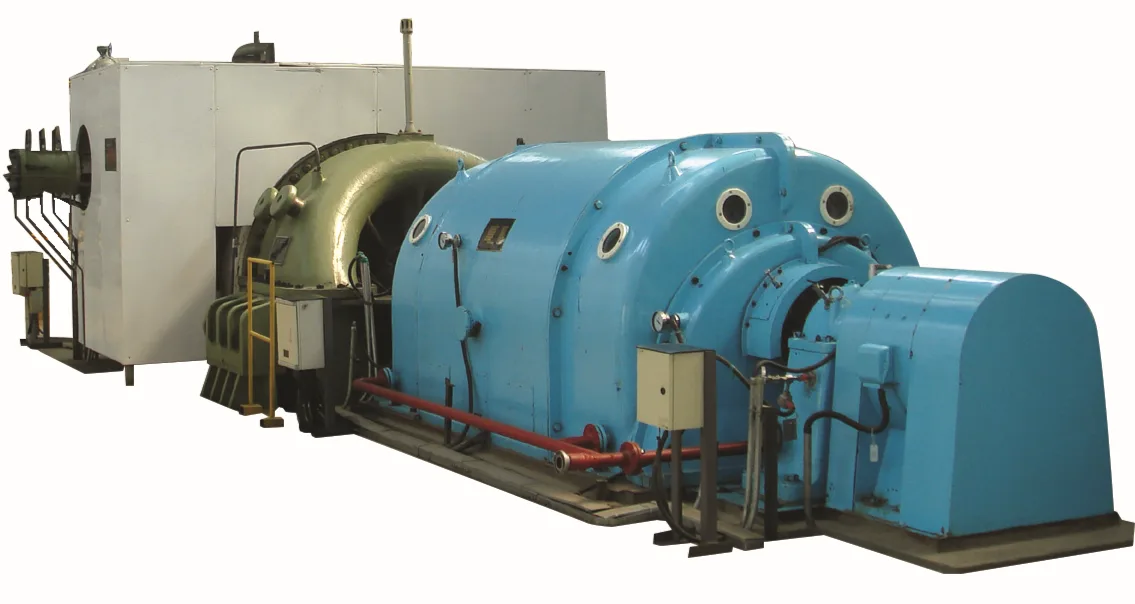
Key facts
- Generator set output 2.5–80 MW, turbine speed 3,000–11,000 rpm.
- Inlet steam up to 540 °C and 14 MPa(a).
- Two designs: condensing (exhaust 0.005–0.3 MPa(a)) and back-pressure (exhaust 0.25–4.0 MPa(a)).
- Downward, upward or axial exhaust — to suit the turbine hall layout.
- A gearbox between the turbine and the generator at high turbine speed.
- Individually designed steam path: high internal efficiency over a wide load range.
Specifications
| Parameter | Condensing | Back-pressure |
|---|---|---|
| OutputMW | 2.5–75 | 2.5–75 |
| Speedrpm | 3,000–11,000 | 3,000–11,000 |
| Inlet steam temperature°C | 470–540 | 470–540 |
| Inlet steam pressureMPa(a) | 0.17–13.2 | 2.0–13.2 |
| Exhaust pressureMPa(a) | 0.005–0.3 | 0.25–4.0 |
| Exhaust direction | downward, upward, axial | downward, upward, axial |
| Standards | API 612, NEMA SM23 | API 612, NEMA SM23 |
Condensing or back-pressure: choosing for an industrial CHP plant
The heat load decides: the back-pressure design is chosen when steam at 0.25–4.0 MPa(a) is needed after the turbine all year round; a condensing steam turbine, when there is no such consumer or it takes steam for only part of the year.
| Criterion | Condensing | Back-pressure |
|---|---|---|
| Where the steam goes | to the condenser; the heat is rejected to cooling water or air | to consumers: process and heating |
| What the output depends on | steam flow through the turbine; heat demand does not limit it | steam demand at the exhaust |
| Additional equipment | condenser, cooling system, condensate pumps, ejectors or vacuum pumps | no condenser or cooling system is needed |
| Data to collect for selection | steam and power balance, source of cooling water or space for an air-cooled condenser | annual steam demand profile by pressure level, including the summer minimum |
Design features
- Steam path
- designed individually for the steam data and load profile — hence high internal efficiency not only at rated load but also at part load
- Exhaust
- downward, upward or axial — the condenser and piping are arranged to suit the hall layout
- Gearbox
- when the turbine speed is above the generator speed, a gearbox is fitted between them
- Standards
- API 612 — special-purpose steam turbines; NEMA SM23 — steam turbines for mechanical drive service, including speed governor classes
- Governing and protection
- electronic speed and load governor, quick-closing trip valve, vibration monitoring and overspeed systems
- Automation
- a turbine generator control system on a Russian control platform — on request
Speed and gearbox
In a steam turbine generator set the speed is set by the grid: a synchronous generator runs at n = 60 × f / p, where f is the grid frequency and p is the number of pole pairs. Turbines in this series run at 3,000–11,000 rpm, and the drive arrangement depends on this:
- 3,000 rpm — the speed of a two-pole generator on a 50 Hz grid: the turbine is coupled to the generator directly, without a gearbox.
- Above 3,000 rpm — on a 50 Hz grid a gearbox reduces the speed to 3,000 rpm (two-pole generator) or 1,500 rpm (four-pole generator).
- 60 Hz grid — the generator runs at 3,600 or 1,800 rpm; state the grid frequency in the enquiry data sheet.
API 612 and NEMA SM23: what they mean for the customer
API 612 sets requirements for the design, fabrication and testing of the turbine; NEMA SM23 covers, among other things, the accuracy classes of the speed governing system. The specification states the edition of the standard and the options selected; the current edition of API 612 is the 8th, November 2020.
| Standard | What it covers | What matters to the customer |
|---|---|---|
| API 612 | special-purpose steam turbines for the petroleum, petrochemical and natural gas industries: design, materials, fabrication and testing, lube oil system, instrumentation and control system | the standard is intended for machines in continuous critical service, usually without an installed spare; the options of the standard are marked in the enquiry data sheet |
| NEMA SM23 | steam turbines for mechanical drive service, including speed governing system classes A to D | the governor class is chosen for the generator’s operating mode: in island operation the turbine governor itself holds the frequency, so the accuracy requirements are higher than in parallel operation with the grid |
Applications
Where they run
- captive CHP plants of industrial enterprises
- block power plants at boiler houses and heat recovery boilers
- small and medium power stations
- CHP plants on biofuel and process waste
The turbine generator set in a plant’s steam system
The set produces power from steam the plant already raises for its own needs. Typical arrangements:
- Instead of a pressure-reducing and desuperheating station (PRDS). The boiler supplies steam at higher parameters than the process units need. A back-pressure turbine uses this pressure drop to generate electricity, and steam at 0.25–4.0 MPa(a) goes to process and heating. The PRDS usually remains as a standby while the turbine is shut down.
- Surplus steam that the process units do not need is converted into electricity by a condensing turbine.
- Steam from heat recovery boilers downstream of gas turbines and process units can also drive the turbine; with a gas turbine this is the steam cycle of a combined-cycle plant.
Check the steam conditions before choosing the arrangement: the series is designed for superheated steam at 470–540 °C at the inlet.
Service and control system after delivery
The company services condensing and back-pressure steam turbines made by Siemens Energy, Dresser-Rand, Mitsubishi Heavy Industries and Howden, and their control, vibration monitoring and speed control systems. Installation supervision and supervision of commissioning of a new set can be provided together with the supply, and in operation — steam turbine repair and adjustment of governing and protection.
Where neither the original software nor the manufacturer’s support is available, the control system is tested on a model before work on site. This is how, in 2024, the company’s specialists tested a digital model of a 2.4 MW Howden steam turbine while preparing its automatic control system for commissioning.
Related
Documents
Sources and standards: the data come from the company’s current website; turbine requirements are set by API 612 and NEMA SM23.
Questions and answers
Condensing or back-pressure — which one?
If the plant needs steam after the turbine (0.25–4.0 MPa(a)) for process or heating — back-pressure: it is simpler and cheaper. If maximum power output is the goal — condensing, with exhaust at 0.005–0.3 MPa(a).
Why a gearbox?
The optimum speed of a 2.5–80 MW turbine is up to 11,000 rpm, while the generator runs at 3,000 rpm. The gearbox matches them and keeps the turbine compact and high-speed.
Why are both 75 and 80 MW quoted?
The data table on the current website gives 75 MW as the upper limit, the section description gives 80 MW. The actual limit for a specific project is confirmed during selection.
How can the output of a turbine generator set be estimated before selection?
The output at the generator terminals is the steam flow multiplied by the available (isentropic) enthalpy drop between inlet and exhaust, the turbine’s internal and mechanical efficiencies and the gearbox and generator efficiencies. That is why, at the same flow, a condensing machine produces more electricity than a back-pressure one. The exact calculation is made during selection from the enquiry data sheet.
Can the set be installed on an existing boiler?
Yes, if the boiler’s steam falls within the range of the series: 470–540 °C, 0.17–13.2 MPa(a) for the condensing design and 2.0–13.2 MPa(a) for the back-pressure design. Selection requires the boiler’s steam capacity, the steam data and the steam demand profile.
Expert in charge
Rotating equipment serviceManufacturers’ names and designations are used to identify the equipment we supply and service. Trademarks belong to their respective owners. Energy Management LLC is an independent engineering company.